Home page
- Report details progress and opportunities for AI to address decarbonisation of the energy system, domestic power and heating, transport, manufacturing, and farming.
- Highlights successes over the past 12 months including how AI is boosting output from wind turbines, cutting consumer costs for heat pump installations, saving millions of pounds in grid-balancing costs, slashing food waste and emissions, and helping farmers spot crop disease.
- Rates 90+ potential applications where AI could accelerate progress.
Amid endless hype about AI, a new report funded by the Department for Energy Security and Net Zero has been published tracking how effectively the technology is actually being applied to decarbonising the UK economy.
Published by the AI for Decarbonisation Virtual Centre of Excellence (ADViCE), the State of AI for Decarbonisation 2025 report reviews how UK applications of AI across nine challenge areas have matured over the last year.
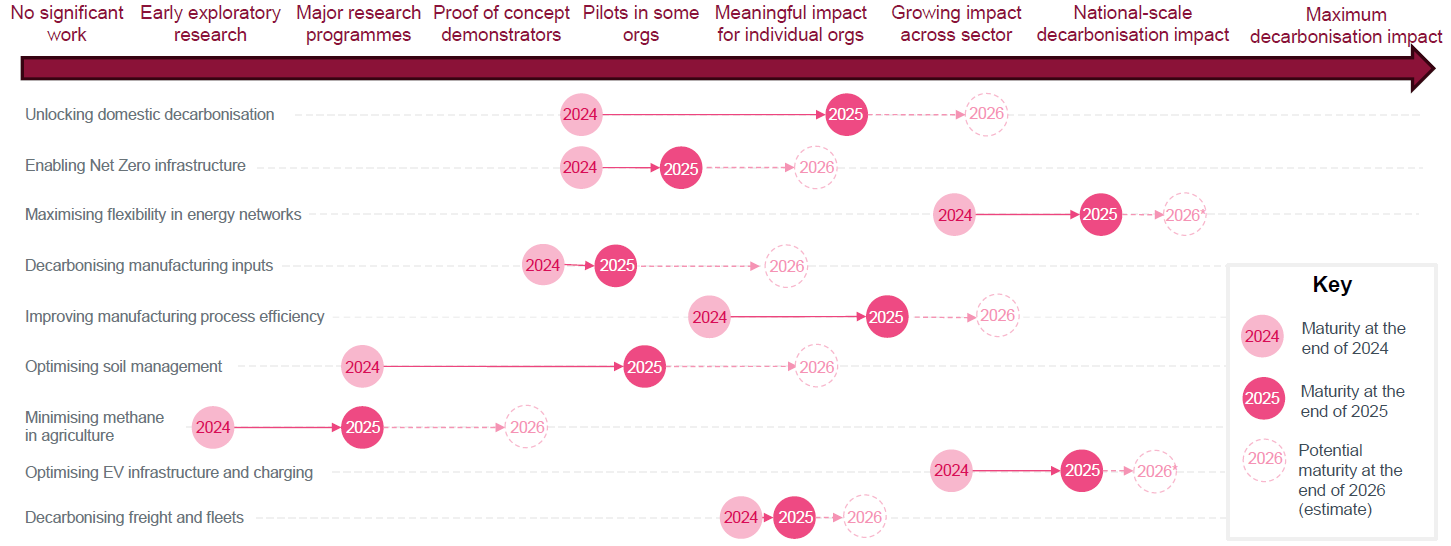
It shows that applications of AI to maximise flexibility in energy networks and optimise electric vehicle charging are already having national-scale impact on decarbonisation.
Sam Young, who is AI Practice Manager at Energy Systems Catapult, one of the co-leads of ADViCE, and the report’s lead author, said: “Indiscriminate use of AI can increase emissions, but smart, targeted uses are already breaking down some of the hardest barriers to a low-carbon economy. It’s particularly encouraging to see progress in crucial, behind-the-scenes applications like heating system design.”
Exploring some of the key technologies, innovators and business models that have achieved success in the past year across 90+ different challenges, the report discusses how:
- AI-enabled solar forecasting is helping the UK’s national energy system operator save £30 million a year in energy balancing costs, eliminating 300,000 tonnes of CO2 emissions.
- Existing wind farms optimised by AI could deliver 3-5% more energy output, enough to power 1 million homes without building new infrastructure.
- Trials using AI to design domestic heat pump installations have reduced costs to consumers by around 75% and halved installation times.
- Cement manufacture, responsible for around 7% of global carbon emissions, can be optimised in real-time using AI, with a trial of the technology reducing emissions by 2% and cutting fuel costs by 4%.
- A large-scale randomised trial showed that using AI-managed charging of electric vehicles can deliver a 42% drop in peak household electricity demand and reduce bills by £343.
- A UK-developed app enabling autonomous drones to inspect crops for disease is being used by 1500 farms.
- Using AI to evaluate millions of possible routes for major energy infrastructure like overhead power lines can slash the time needed for planning studies by as much as 93%.
- Researchers using AI to rapidly explore thousands of material designs per day have identified how to increase the energy density of batteries by 10%, in a push to extend the driving range of electric vehicles.
- A trial using an AI platform to optimise supply chains between manufacturers, buyers and logistics firms reduced food waste by 87%.
Work on AI to address some major challenges like reducing methane in agriculture and optimising soil management is still at an earlier stage, but 2025 saw some promising developments and encouraging pilots.
However, the report identifies that progress has been slow on applying AI to decarbonising manufacturing inputs and electrifying freight, partly due to the high capital costs that need to be overcome to achieve decarbonisation in those areas.
The report also looks ahead to the coming year and identifies areas where conditions are ripe for rapid progress. It identifies both enablers such as increasing data availability or market maturity, and gaps and barriers like a lack of interoperability that need to be overcome to unleash the technology’s potential.
The chart below shows how far AI solutions for each grand challenge have progressed between 2024 and 2025, along with an estimate of potential progress in 2026. Open the chart in new tab to view a larger version.
Professor Emily Shuckburgh, Chief Scientific Adviser at the Department for Energy Security and Net Zero, said: “This exciting report provides example after example of how AI is being deployed to decarbonise our world. It showcases a rapidly growing sector, supported by collaboration between industry, academia, and government, and underlines the value of government initiatives such as ADViCE in bringing that ecosystem together. As AI tools and data infrastructure continue to develop, their contribution to emissions reduction, lowering consumer costs and generating economic growth opportunities in the UK is becoming increasingly clear.”
Professor Adam Sobey, Mission Director for Sustainability at the Alan Turing Institute, said: “Recognising the urgent need to reduce emissions, this report showcases the proven potential of AI and data science to advance the sustainability agenda, helping to build an ecosystem confident in using these technologies to tackle decarbonisation challenges and accelerate progress towards net zero.”
Beth Medlik, Principal for Clean Energy and Decarbonisation at Digital Catapult, said: “This report cuts through the hype and provides clean tech investors and public sector funders with an up-to-date view of how effectively AI is being applied across the net zero system to address a broad range of decarbonisation challenges.”
Download the report here.
Notes for editors
The AI for Decarbonisation Virtual Centre of Excellence (ADViCE) is part of the UK government’s AI for Decarbonisation Innovation Programme, which accelerates the development of innovative artificial intelligence (AI) technologies for decarbonisation applications, to support the UK’s transition to Net Zero. ADViCE is a partnership between Digital Catapult, Energy Systems Catapult and the Alan Turing Institute.
Enquiries
Adam Duckett
Communications Officer
Energy Systems Catapult
Email: Adam.Duckett@es.catapult.org.uk