Want to know more?
Find out more about how Energy Systems Catapult can help you and your teams
Get in touch
Want to know more?
Find out more about how Energy Systems Catapult can help you
Creating a Carbon Reporting and Innovation Office would deliver a step change in the quality, accessibility and comparability of emissions data.
Carbon accounting – the process by which organisations collect, analyse, and disclose emissions data – is rapidly becoming an important part of market infrastructure, both in the UK and internationally.
Done well, it provides investors and innovators with the confidence that their product or service has a place in growing low-carbon markets. It influences strategic decisions at a business level, including which decarbonisation routes to choose, which customers to serve, and which markets to enter. It’s also essential for more effective policymaking.
Our new report ‘A Foundation for Economic Growth: Implementing a Carbon Reporting and Innovation Office’ explores the challenges with how carbon accounting is done today, and sets out why this matters when it comes to unleashing UK innovation.
Currently, businesses – ranging from SMEs to heavy industry – face a time-consuming and resource-intensive process, as they navigate a range of siloed regulations and incompatible standards.
Meanwhile, those using emissions data to guide their decision-making can find that it lacks transparency, consistency and comparability. This acts as a brake on public and private investment into, and the deployment of, low-carbon products and services.
Our proposal for a Carbon Reporting and Innovation Office (CRIO) aims to address these challenges and enable the production of high‑integrity, decision‑ready emissions data across the economy.
CRIO would seek to improve regulatory coordination, reduce administrative burden for businesses and innovators, and enable emissions data to be reused across different regulatory and market contexts.
CRIO would do this by:
These priority regulatory functions are set out in more detail in the timeline below.
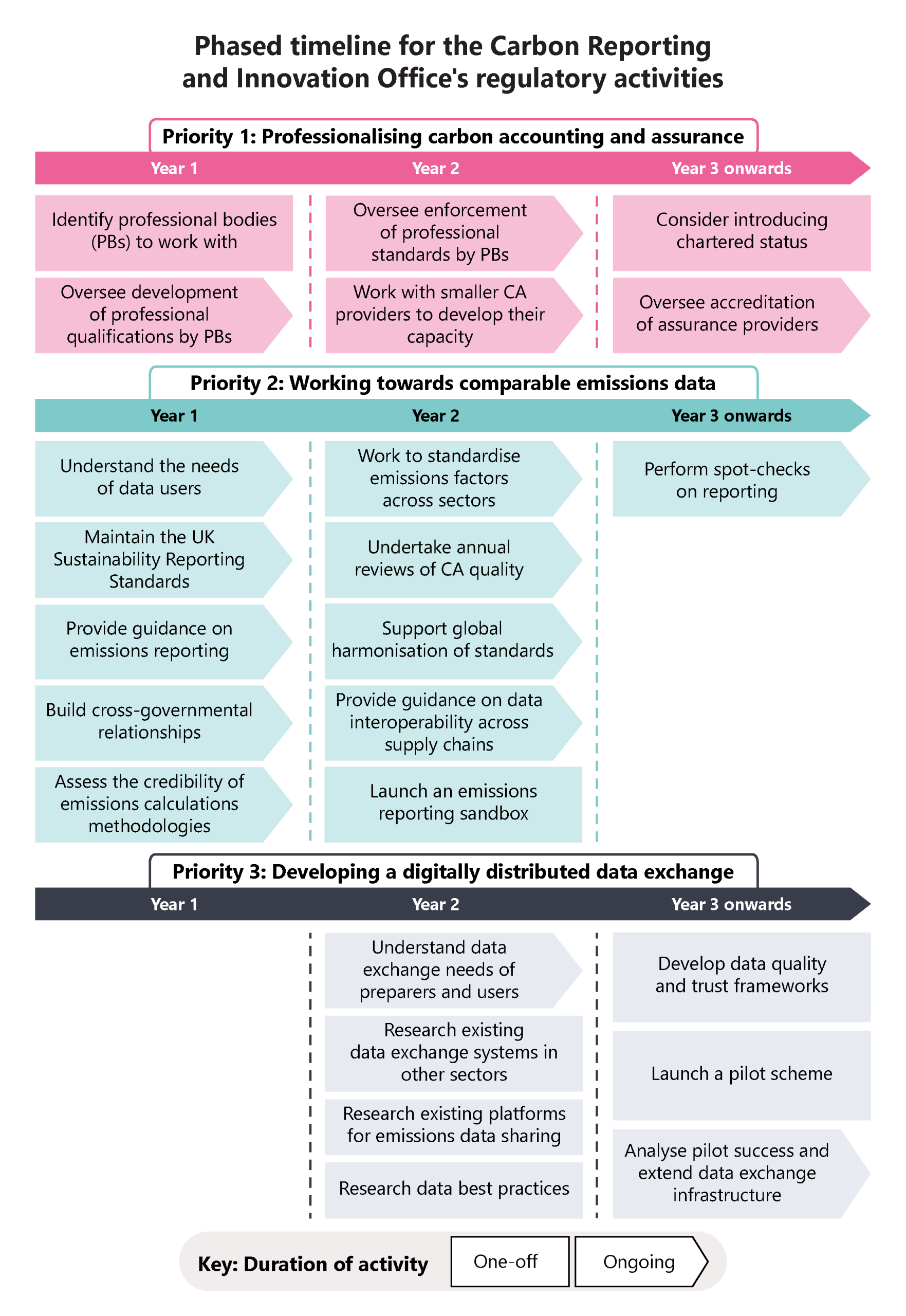
Our recommendation is that CRIO would be housed within the Financial Reporting Council (FRC). This would allow it to build upon existing expertise within the FRC about the preparation and use of company data, especially relating to sustainability reporting requirements.
It also means that CRIO could be implemented relatively rapidly, potentially becoming operational within 12–18 months, as shown in the timeline below.
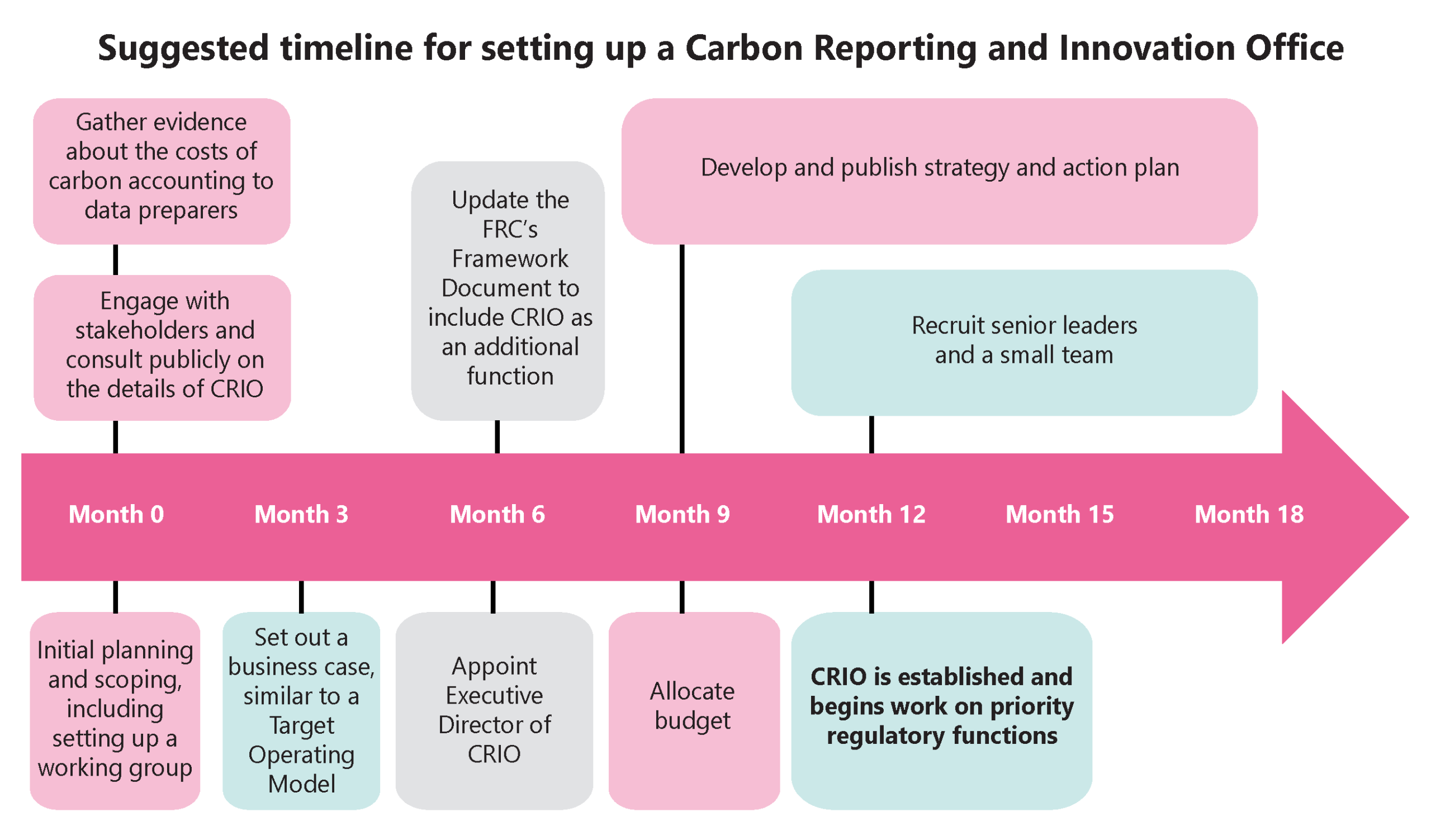
We think its resourcing requirements would be modest with 30-50 staff members and a total budget of £2-5 million per year, funded in the long-term by a levy on the carbon accounting sector.
We recommend that any future plans for the FRC include provisions for its structure and remit to incorporate CRIO.
Under the Regulation Action Plan, government has committed to reduce regulatory admin costs for businesses by £5.6 billion by the end of Parliament. CRIO and its work to streamline carbon accounting would form a valuable part of the regulatory reforms needed to deliver on this target.
If implemented, CRIO would enable:
There is a real opportunity for the UK to lead the way in carbon accounting services, following in the footsteps of its financial accounting sector.
CRIO would enable a step change in the evolution of carbon accounting, supporting UK growth, innovation and international competitiveness over the decades to come.
Read our full recommendations here.
An Energy Systems Catapult thought leadership project, focusing on how the UK can develop an innovation-friendly, economy-wide framework for Net Zero.
Click here for moreFind out more about how Energy Systems Catapult can help you and your teams
Find out more about how Energy Systems Catapult can help you