Want to know more?
Find out more about how Energy Systems Catapult can help you and your teams
Get in touch
Want to know more?
Find out more about how Energy Systems Catapult can help you
Households trapped in leaky, inefficient homes will face an impossible choice this winter, as high energy and food costs force many to choose between heating or eating. To protect the most vulnerable, we need to rethink how support is delivered.
One emerging answer we’re working with the government on is moving beyond funding measures and instead paying for outcomes – using contracts to buy lasting improvements in people’s health and wellbeing, rather than narrowly focusing on specific energy efficiency upgrades.
Without the right solution, the energy transition could end up leaving the most vulnerable behind, plunging at least 14,000 more households into fuel poverty and contributing to missed clean energy targets.
Encouragingly, the government’s recent Warm Homes Plan consultation shows that space for real innovation is opening up for equally innovative finance that helps achieve societal outcomes.
And we need this because finding the right solution is literally a matter of life and death. More than half of fuel poor households include someone with a health condition or long-term illness, leaving the NHS spending an estimated £900 million a year treating people made ill by living in cold or damp homes.
In the current setup, the health sector bears the cost of addressing this, yet it’s the energy sector that has a legal duty to identify and support fuel-poor homes. There’s been different funding mechanisms and incentives to deliver energy efficiency measures, advice and safety support over the last decade. However, the funding sources haven’t always worked together or been targeted effectively at those who suffer most, with problems of fragmented delivery and regulatory constraints.
The challenge with market-based fuel poverty interventions is that they inevitably pit profit-based motives against social need. We’ve seen this in schemes like the now-scrapped Energy Company Obligation (ECO), which had incentivised suppliers to deliver obligations as cost-effectively as possible to remain competitive.
Through our pioneering Warm Home Prescription, Energy Systems Catapult has proved how better health outcomes and energy-efficient homes can be delivered to those most at risk. We’ve spent years rigorously testing this cross-sector service with real patients and energy consumers.
Our approach uses health data to identify the people most at risk, and we work with the energy sector to make sure they get the support they need to have a warm home.
The key barrier to scaling this approach is that the savings in health costs aren’t valued or monetised within the delivery of existing programmes or policies. We’ve been exploring how to overcome this – looking at how different funding and financing streams can be brought together not only to retrofit homes but crucially deliver warm home outcomes.
The Department for Energy Security and Net Zero (DESNZ) has asked for evidence and initiatives that support how societal savings could be taken into account with retrofit. But it needs a workable business model. The key questions are: how can health benefits be monetised? How can an outcome be purchased? How can an outcome be delivered?
Traditionally, the value of retrofit has included carbon savings, but it could also capture improvements in individuals’ health and cumulative healthcare savings.
Through market research and stakeholder interviews, we’ve identified four key components that need to be addressed to design a viable business model that delivers retrofit and a warm home outcome:
Our starting point was to consider the scale of delivery, ability to capitalise on existing arrangements and the time we have available to support the household. The options were then categorised by ‘time to deliver’ and ‘scale of delivery’, as shown below.
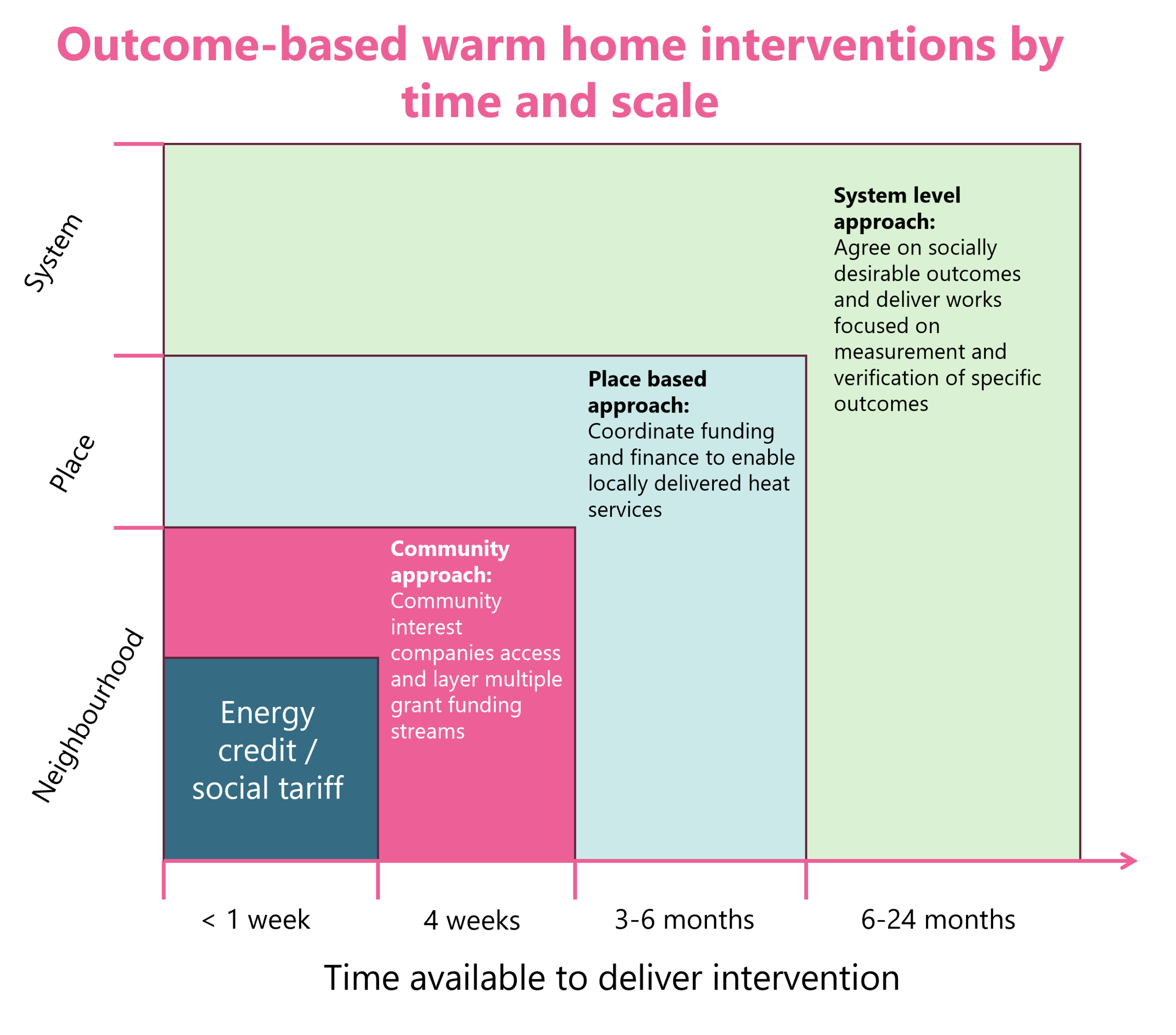
Following this analysis, we’ve developed and tested business model options and concluded that there is a good fit with the four key components in a place-based approach.
The model we’re now testing with stakeholders is called a Social Outcomes Contract where an organisation (called ‘a commissioner’) can buy an outcome, such as an improvement in people’s health, rather than buying a certain number of energy efficiency measures or advice to a certain number of householders. A local NHS region could buy a warm home outcome from energy advisors or energy installers for instance.
Resonance, the social impact fund, provides an excellent description of Social Outcomes Contracts:
“Social Outcomes Contracts (SOCs) are contracts for the delivery of services to improve outcomes for people with complex needs, where some or all of the contractual payments are linked to the achievement of specified outcomes for a particular group of beneficiaries and where the contract relies at least partly on social investment. They are sometimes known as Social Impact Bonds (SIBs) or Social Outcomes Partnerships (SOPs).
“SOCs have a particular value in addressing complex social needs, where innovation and flexibility in service design are required to personalise services and deliver better and faster outcomes than traditional siloed public services can achieve. There is often an element of early intervention too, reducing potential future costs for public services.”
This model has real value because:
We’re now testing this business model in detail with key stakeholders and will share our updated findings this Summer.
We’re on the cusp of an exciting and urgently needed fix here – a funding and business model that can be scaled to help warm the homes of those most at need, save costs for our over-stretched NHS, boost energy efficiency, and open up new opportunities for UK innovators developing clean energy technologies and services.
There isn’t anything controversial in a new model like this. Throughout our work on Fair Futures, I’ve seen firsthand that the government, the energy suppliers and truly anyone working with energy consumers is committed to maintaining and improving the health of the UK population – but we need to find a way that guarantees it’s delivered more effectively. This remains a powerful and transformative opportunity.
Find out more about how Energy Systems Catapult can help you and your teams
Find out more about how Energy Systems Catapult can help you