Data-driven: helping SGN build an integrated view of its industrial and commercial customers
Project complete
SGN wanted to develop a clearer, more integrated view of its industrial and commercial customers, which make up a significant part of its network demand.
Energy Systems Catapult delivered a structured data integration programme, combining geospatial mapping, new classification methods, and validation techniques.
By bringing together multiple datasets, introducing spatial intelligence and enhancing customer classifications, the project provided the evidence SGN needed to support customer engagement, decarbonisation planning and network decision-making.
SGN manages around 190,000 industrial and commercial customers, which represents around 40% of the energy transported across its network despite accounting for only around 3% of the customer base.
SGN recognised an opportunity to bring together a wide range of existing customer and network datasets into a more integrated view that could better support strategic decision-making.
The stakes with these customers are high: large industrial sites can significantly shift local network demand as they adopt low-carbon technologies or cut gas use. A richer understanding of customer activities, locations and future energy requirements is key to anticipating how demand may change over time.
This would help SGN identify priority customers, support future network investment decisions and inform place-based initiatives such as Regional Energy Strategic Planning (RESP).
Energy Systems Catapult designed a phased approach to strengthen SGN’s understanding of its industrial and commercial customer base, focused on three priorities:
Baseline data improvements: we geocoded customer addresses using Python and ArcGIS, linking each record to Ordnance Survey building data. This unlocked precise spatial mapping and rich building-level attributes. We improved customer classification, giving SGN a more relevant and actionable understanding of industrial and commercial activity.
Enhanced data validation: for priority customer segments, we combined automated matching with manual review and drew on external datasets to further enrich the dataset.
Ongoing updates: we developed a repeatable approach to refreshing the dataset, providing SGN with a scalable way to continually enhance its understanding of customers, demand trends and potential future energy requirements.
The Catapult’s geospatial expertise and experience delivering large-scale data platforms, including InSite, helped SGN turn complex datasets into practical insights that support decision-making.
The project combined expertise in GIS, data science and stakeholder engagement, ensuring technical delivery remained aligned with SGN’s strategic priorities.
The project established a unified platform bringing together customer, spatial and external datasets covering around 190,000 industrial and commercial customers.
This provides SGN with a more comprehensive and strategically useful view of its customer base, supporting both operational and long-term planning activities.
SGN can now explore customer and network relationships in greater detail, spotting patterns, clusters and priority areas for engagement and intervention.
SGN is now better placed to:
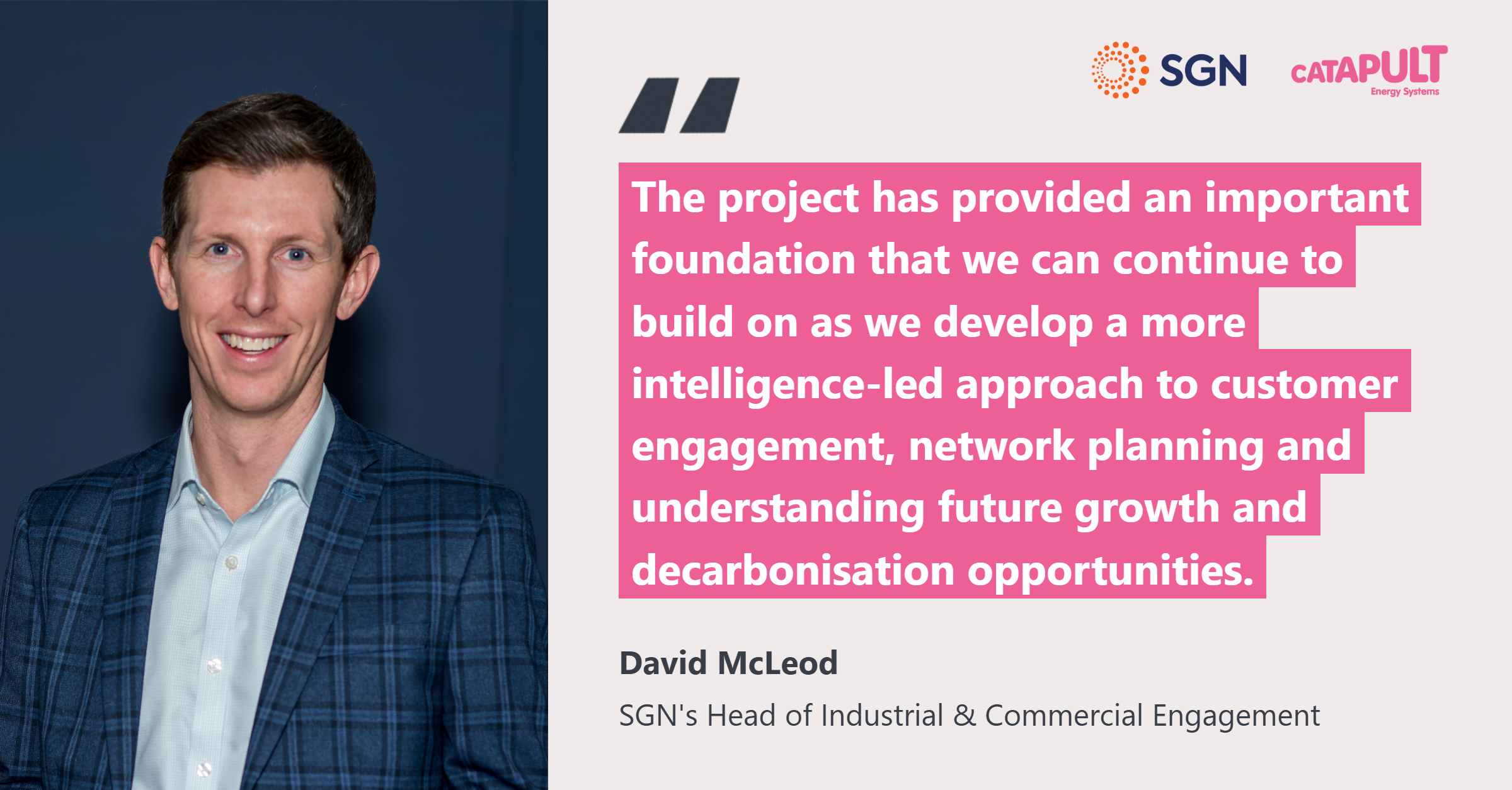
“Industrial and commercial customers account for a significant proportion of the energy transported across our network, making it important that we understand not only current demand but also how customer requirements may evolve through the energy transition. Energy Systems Catapult brought a valuable combination of geospatial expertise and data science capability, helping us strengthen our understanding of around 190,000 industrial and commercial customers. The project has provided an important foundation that we can continue to build on as we develop a more intelligence-led approach to customer engagement, network planning and understanding future growth and decarbonisation opportunities.”
Looking to build a stronger evidence base for decarbonisation planning and network decision-making? We can help you develop the data, insight and evidence needed to support decarbonisation planning and investment decisions.
Get in touch with Christine St John Cox or Craig Mellis to find out how advanced data, geospatial tools and sector expertise could transform your organisation’s approach to complex energy challenges.