Carolyn Hicks co-founded Brill Power, built a new class of intelligent battery management systems, and became Innovation Director at Palmer Energy Technology when it acquired her company in 2025. She tells Energy Systems Catapult what it really takes to scale a clean energy business.
What first made you question how batteries are used?
Fifteen years ago, I didn’t think much about them, never mind the fact that I carried one in my pocket at all times. Then I met the experts who study them for a living, and learned my phone isn’t measuring how charged it is at all. It’s guessing.
And while ‘guessing’ is certainly not the right term for a data-driven mathematical model, I was still surprised that State of Charge is calculated, not measured. That was the first surprise.
The second was bigger. A battery pack can only be worked as hard as its weakest cell. So huge numbers of perfectly good cells are retired early with a great deal of life still in them. Our analysis of published cell-variation data suggests around half of all cells still hold half their useful life when discarded.
I remember doing the arithmetic. Are we really throwing away a quarter of the useful life of all batteries we manufacture?
That question is why I do what I do.
How is Brill Power disrupting battery technology?
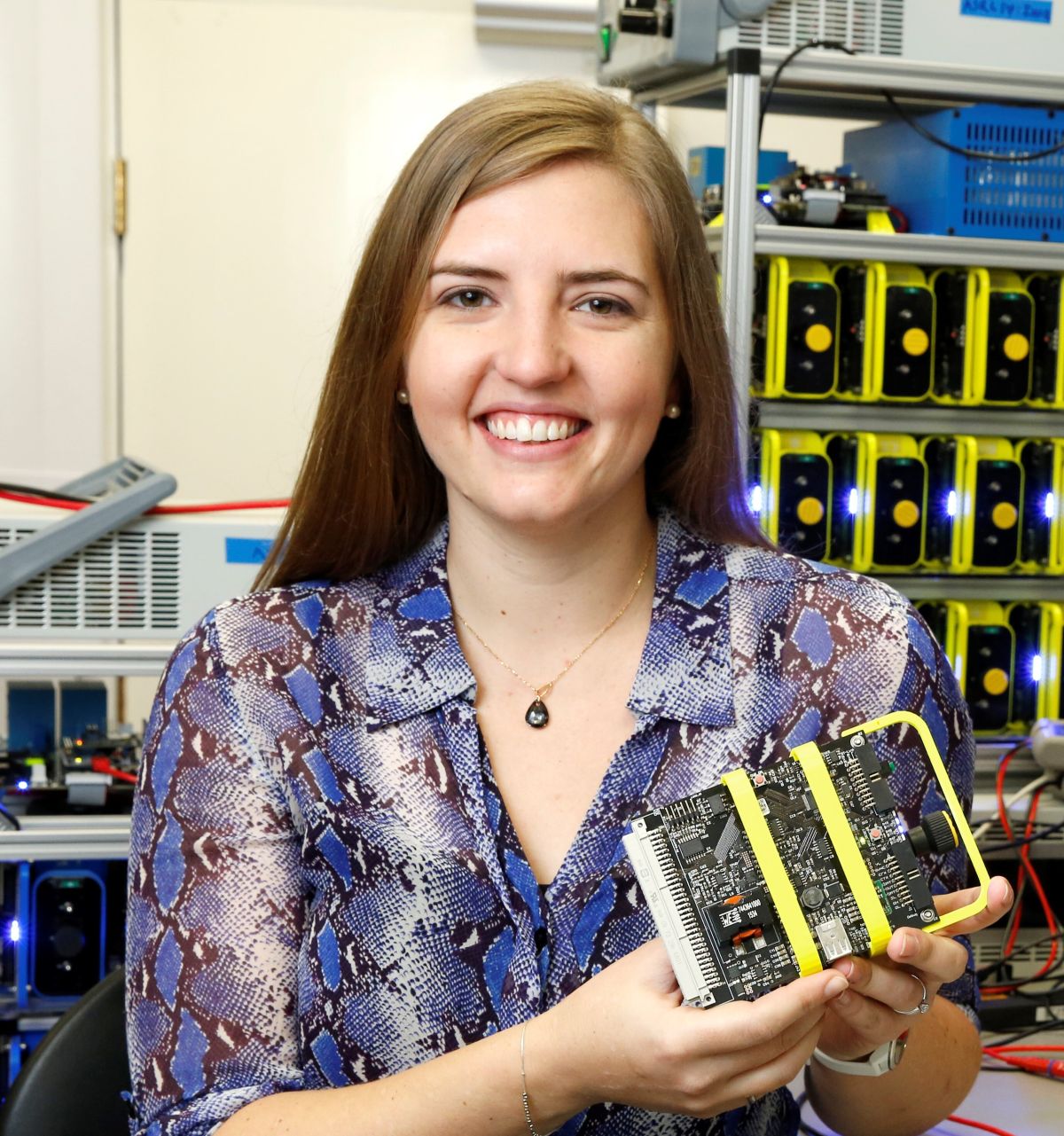
Carolyn with an early-stage prototype
The simplest answer is that we help batteries work better and last longer.
Our technology charges and discharges each battery at a more granular level, allowing more of the available energy to be used while reducing unnecessary degradation. Every battery should deliver more value from the materials, energy and investment that went into making it.
What began in 2014 as technology developed at the University of Oxford is now hardware and software combining battery management, active cell-level control and analytics – making large-scale energy storage cheaper, easier to maintain and more sustainable.
How did you come to launch Brill Power?
If someone had told me when I was young that I would be the co-founder of a deep-tech company, I would have laughed – surely, I would never have the confidence to do something like that.
I never aspired to be an entrepreneur. I trained as a civil engineer and spent five years in engineering and transportation planning, looking at how infrastructure shapes cities. I moved gradually towards the commercial side, and while completing an MBA at Oxford’s Saïd Business School, I found myself in a meeting room to discuss an entrepreneurship project.
That is all it was meant to be. A course requirement. One credit, tick the box.
That meeting is where I first heard about cell-level control, and about the battery in my pocket that was only ‘guessing’. I went in expecting to write it up and move on.
Once I understood what the technology could do, I couldn’t walk away from it.
I founded Brill Power in 2016 with three co-founders – the people who had been explaining batteries to me in that meeting room.
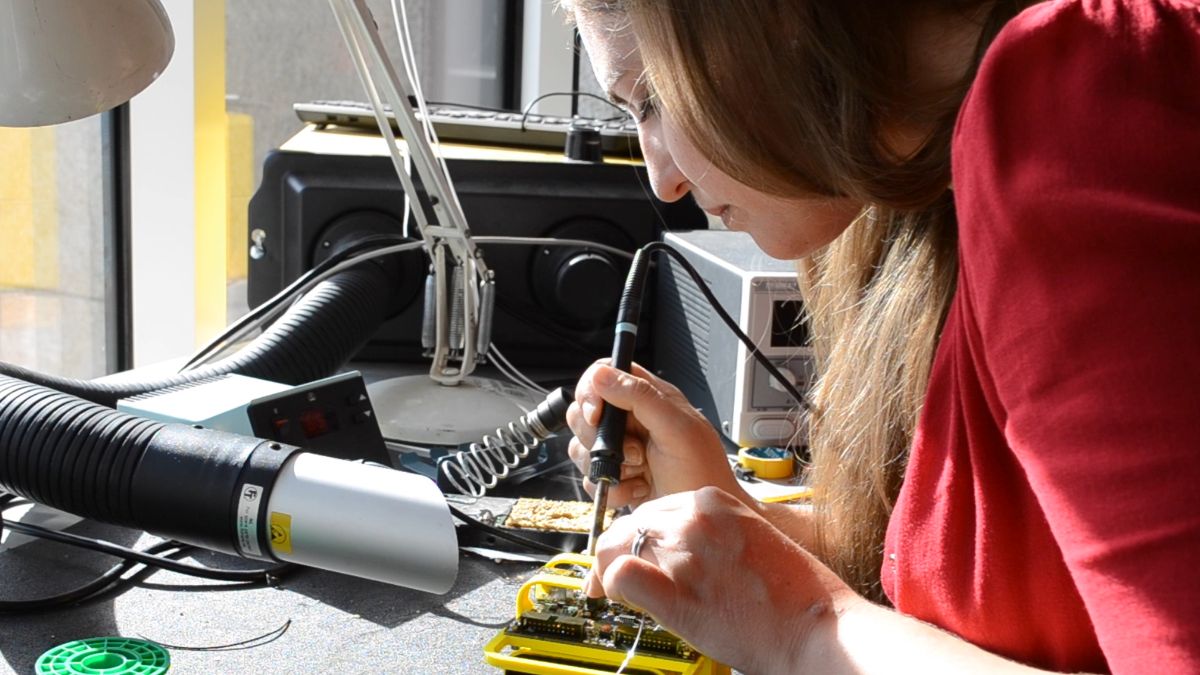
Carolyn soldering Brill Power’s early-stage prototype
Our earliest days were spent building traction however we could: startup competitions, technology milestones, customer MOUs, small grants. Then we started to grow with standard corporate cycles: funding, hiring, technology development, product launch, repeat.
Looking back, it seems straightforward. Living it felt like anything but.
Tell us about a time when things didn’t go to plan
A few years into our product development, we were building the first full-system prototype of our latest technology. Hundreds of design decisions go into a first system. We had just iterated the electronics and were putting them into a battery system built by a supplier. Delivery was due just before Christmas.
I wasn’t on site during the delivery, but my co-founder rang.
“Carolyn, the battery doesn’t fit through the door of the building.”
The technical specifications were almost perfect, but we had missed a key point on overall size. The delivery truck unloaded not one, but two large battery packs onto the pavement outside our office. They were about double the size of a washing machine and, unfortunately, too wide to fit through the door of our lab. We had no way of getting them inside. At least it wasn’t raining.
Entrepreneurship is solving a series of problems that you’ve never faced before – and alongside many things, this was a first.
Thankfully, we had designed in the ability to split the battery system into its parts. Pulling out the battery modules, we were able to bring the critical elements into the lab while the empty casings were hastily tucked under a tarpaulin behind the building.
We got our prototype. But nobody warns you that the thing standing between you and a working system might be the size of an open doorway.
Scaling a cleantech business is never straightforward. For someone earlier in the journey, what obstacles are worth planning for?
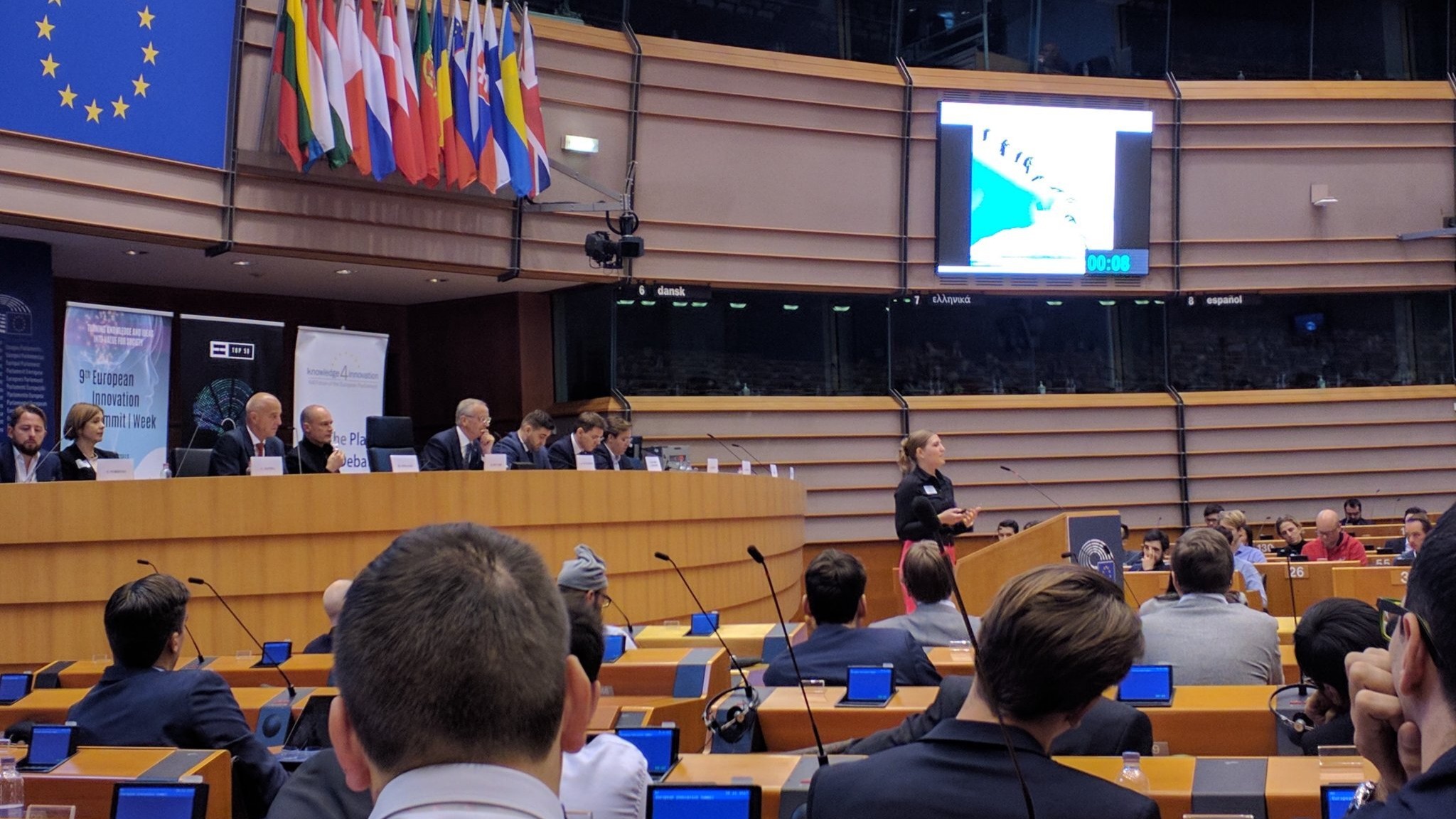
Carolyn pitching at the EU for top 50 European Cleantech startups 2017
Development cycles are long, and customers rightly expect extensive evidence before adopting new technology in critical infrastructure. Certification and safety standards take time and iterations are time consuming.
One of my biggest lessons has been learning how to manage several forms of risk at once. Relying on a single project, customer or route to market can leave your business exposed. That’s why we developed hardware, software, analytics and commercial relationships in parallel, giving us more than one path forward.
Then there’s funding, which is a continuous challenge. Hardware businesses often need considerable initial investment in order to develop technology and innovations into products.
That means looking for funding options from various sources. Working with my co-founders and team, I have raised over £19 million in equity and grant funding, with support coming from venture investment, government-backed research programmes and strategic partnerships. At our peak we were a team of more than 50. As soon as we closed one funding round, we were already looking at what was needed to achieve the next.
It helps to have a clear plan – technically, commercially, financially. This helps communicate to others what success looks like. As a startup founder, it’s easy to forget that not everyone is constantly thinking about your business and what it can accomplish. A clear plan also allows you to take an engineering approach – break down a problem into its parts and tackle each one to work towards a common vision.
The scale-up gap is not only about money. It is about finding the people, supply chains, customers and evidence required to turn a prototype into a repeatable commercial product. In 2025, Brill Power was acquired by Palmer Energy Technology, which delivers energy storage for utility-scale, and commercial and industrial customers. The combination brings our active loading technology, software and analytics together with Palmer’s engineering, manufacturing and delivery capabilities.
Developing advanced technology is one challenge. Getting it deployed and trusted is another. Keep an eye out for partner companies who can turn your technology into a trusted, deployable product – sometimes the fastest way to scale isn’t doing it alone.
What advice do you have for other women entering cleantech?
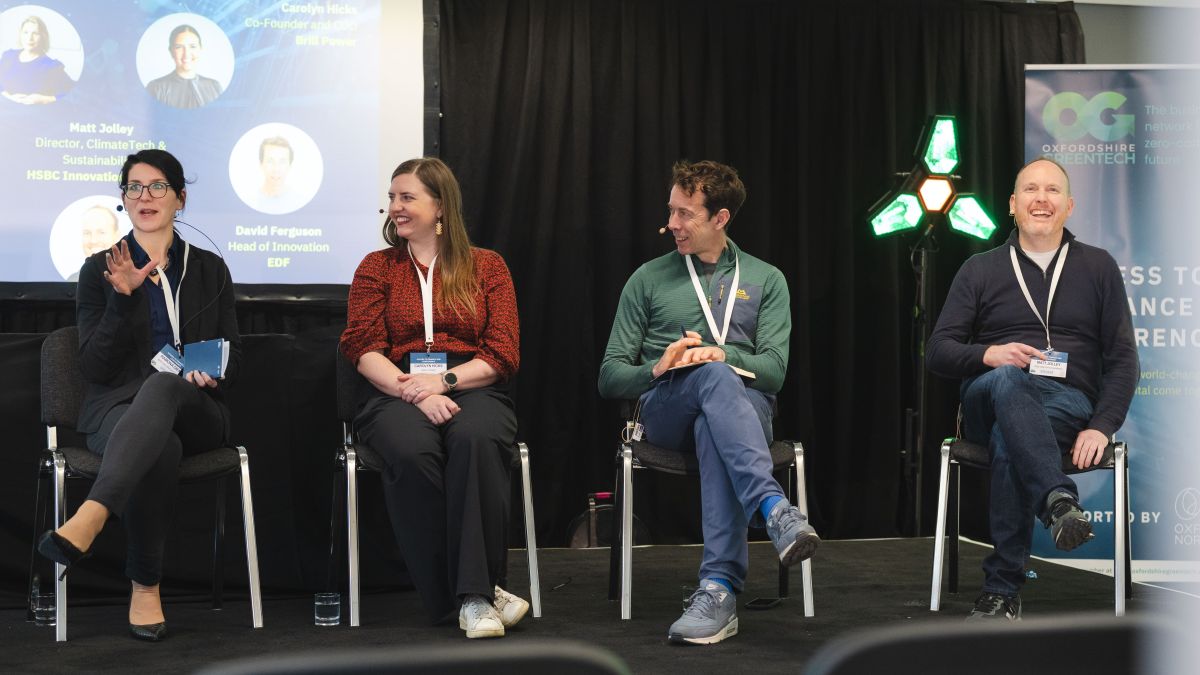
Carolyn speaking at the Oxfordshire Greentech Access to Finance event 2026
Don’t wait until everything feels perfectly in place. Clean energy needs engineers and scientists, but also people in finance, operations, policy, manufacturing and commercial development. There is no single correct background.
Talk confidently about what you have achieved. People cannot support you, invest in you or offer you an opportunity if they do not understand what you can do. That is not arrogance. It is useful information.
Find your allies. I am often the only woman in the room. For a long time, our Board of Directors had more people named Chris than it had women. But for all that time, the people around the table were my allies. They trusted my inputs and we supported each other’s work.
How has Energy Systems Catapult supported you along the way?
Energy Systems Catapult continues to support Brill Power and Palmer Energy through its Energy Launchpad programme. We are working with them to refine our segmentation, update our route-to-market plan and develop new project partnerships.
Clean energy innovation is never the work of one company alone. The Catapult has helped us articulate the opportunity; Palmer Energy provides the industrial platform to deliver it.
Together, they are helping turn advanced UK battery technology into real systems supporting the path to a clean energy future.
Book a free SME growth consultation
This free-to-attend consultation is for organisations with products or services they believe could be sold into the energy sector.
Find out more