Back to the energy future

How WESA provides a time machine for energy trials
History is filled with confident predictions that were quickly overtaken by technological development and changing consumer behaviour. Predicting the energy system of the future presents a similar challenge, because technologies, consumer behaviour, market rules and physical infrastructure are all changing at the same time.
WESA acts as a time machine for energy trials, allowing network operators to test plausible future conditions before they exist at scale. For electricity network operators, modelling is an essential part of planning. Models can estimate future demand, explore different technology uptake scenarios, and help engineers understand where constraints might emerge. They are also relatively cost-effective, making them a sensible way to narrow down the range of futures a network needs to consider.
The difficulty comes when the future begins to look very different from the past. It is difficult to fully foresee the challenges electricity networks will face as EVs, heat pumps, batteries and solar PV become more widespread.
A model might assume, for example, that offering cheaper electricity overnight will encourage EV owners to move charging away from the evening peak. At low levels of EV adoption, that may work well. But if enough people respond to the same signal, the intervention can create a new peak instead.
That is already visible in Energy Systems Catapult’s Living Lab smart meter data. In an analysis of 854 homes, at around 48 per cent EV uptake, the largest daily demand peak had shifted into the middle of the night and was twice the size of the traditional evening peak.
The problem is not that a model is wrong. It is that models depend on assumptions about how technologies and people will behave. Real consumers are less predictable. They may respond differently to tariffs, ignore them altogether, or react in ways that only become apparent once a service is being used.
Historical data has limitations too. The behaviour we observe today has been shaped by today’s tariffs, regulations and market structures. Change those conditions and the behaviour may change with them.
Testing the future before it exists
The Whole Energy Systems Accelerator, or WESA, combines real household demand and controllable low-carbon technologies with simulated network and market conditions so that networks can test future scenarios safely before they exist at scale.
This means Energy Systems Catapult can take homes from all over the UK in Living Lab and treat them as a virtual community connected to the same simulated local network. A neighbourhood in which almost every household owns an EV may not yet exist, but WESA can create an equivalent community using the real electricity demand of EV-owning households located around the UK.
That demand can then be mapped onto a simulated distribution network at PNDC, the Power Networks Demonstration Centre at the University of Strathclyde. If the simulation identifies a network problem, such as excessive loading, WESA’s market emulator can alter the pricing or control signals being sent to participating homes and observe how people and their technologies respond in real time.
WESA can also emulate future market conditions. Researchers can test hypothetical tariffs, regulations and business models that do not yet exist, while participants experience a realistic proposition through communications and simulated bills.
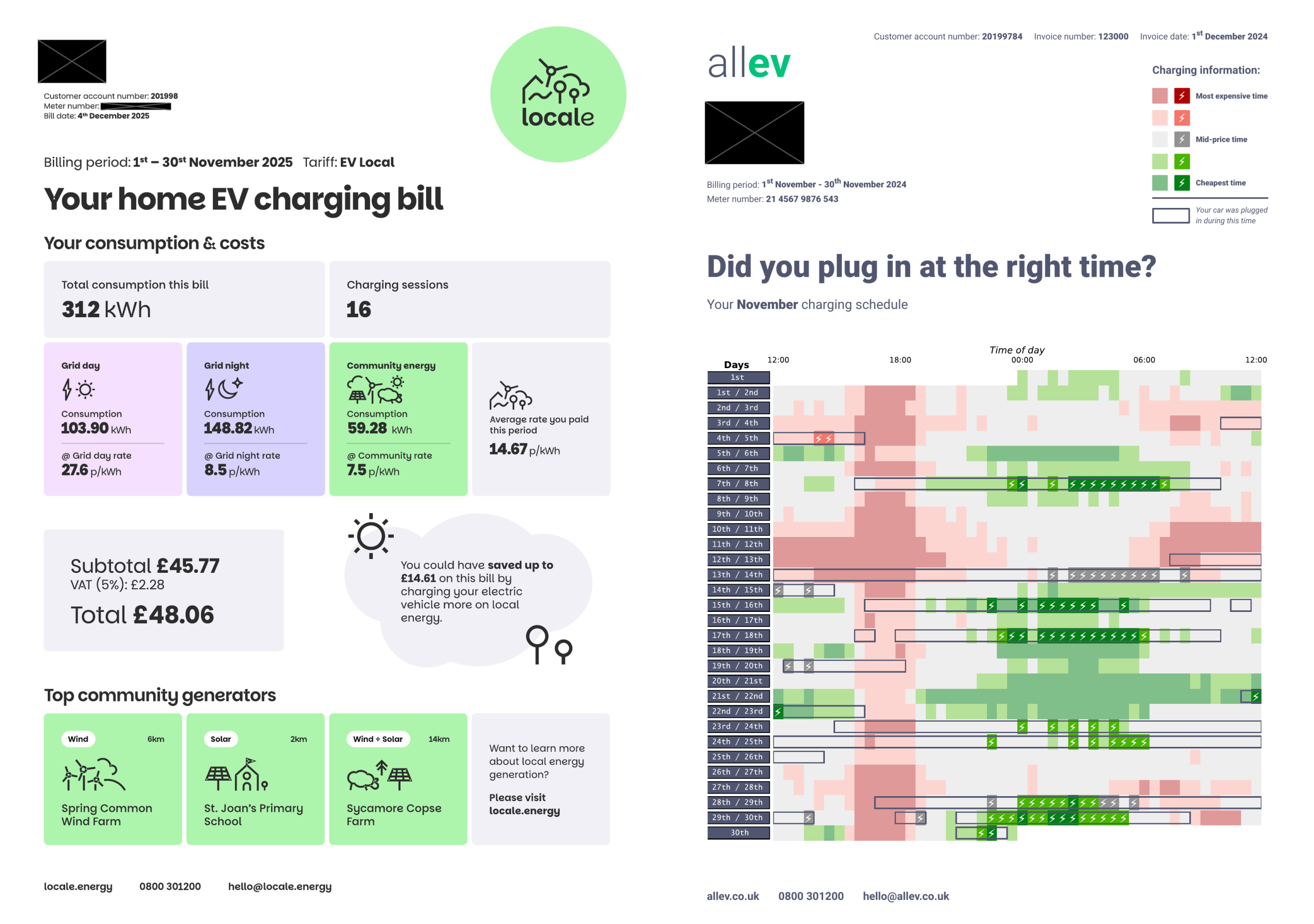
Simulated bills are sent to participants to create a realistic experience of living with a new energy proposition
This approach has already been used with Scottish and Southern Electricity Networks (SSEN) to investigate alternatives to traditional Load Managed Areas in northern Scotland. The project flexed EVs, heat pumps and storage heating across up to 200 Living Lab homes, while mapping their demand onto a simulated secondary substation. The lessons from this project have informed SSEN’s pathway to adopt one of these methods – Dynamic Congestion Response – in business-as-usual with day-ahead operation.
WESA is therefore not a replacement for every model or every network-planning exercise. Modelling remains a valuable and cost-effective way to explore scenarios and identify the questions worth investigating. But when the answer depends on how real consumers, technologies and future market arrangements interact, testing those assumptions can provide an additional level of confidence.
For network operators planning for a system that does not yet exist, sometimes the best way to understand the future is to create it first.
Do you want to test a new energy product, service or policy innovations with real consumers under future energy market and network scenarios?
Get in touchFind out more about how Energy Systems Catapult can help you and your teams
Find out more about how Energy Systems Catapult can help you