Want to know more?
Find out more about how Energy Systems Catapult can help you and your teams
Get in touch
Want to know more?
Find out more about how Energy Systems Catapult can help you
The UK government’s plan to remove the Carbon Price Support (CPS) from April 2028 is a pragmatic choice to help reduce bills in the near-term and simplify the tax and carbon pricing system, but it doesn’t go far enough to enable the long-term transition to clean heating.
To recap, the CPS is a tax on fossil fuels applied to electricity generators that was introduced in 2013 and has remained frozen at £18/tCO2 since 2016. It was intended as a top-up to the then low allowance price of the EU ETS. Ultimately it was used to eliminate coal-fired power plants from our energy system, which it accomplished last year.
“CPS has done its job and is no longer fit for purpose. Coal has been driven off the grid and the ETS has matured, with a tighter cap to drive the signal for electricity generators to decarbonise, so now is the right time to simplify the tax and carbon pricing system” – Dan Tomlinson, Exchequer Secretary to the Treasury
While not an explicit aim of government, removing the CPS can also go some way to enable the electrification of heat. It will, for the first time, reduce the effective carbon price of household electricity to below that of gas. This is not only important for consumers, but vital for opening up markets for innovators. By levelling the playing field, companies are able to provide offerings that are not only low carbon, but give the end-user a better experience compared to today’s status quo.
But carbon pricing still has an important role to play in shifting our reliance away from using gas to heat our homes. Our research shows that in the medium- to long-term, the UK should extend the UK Emissions Trading Scheme (ETS) to include gas heating, but more on that later.
The ‘effective carbon price’ is the cost that a business or individual pays for the greenhouse gas emissions they produce from a given activity – in this case from consuming fuel.
The effective carbon price is the sum of direct carbon policies (including explicit carbon pricing instruments, energy and fuel taxation) and indirect carbon policies (including reduced VAT rate, subsidies for low- and zero-carbon options) per ton of emissions produced, avoided, or removed.
When a high effective carbon price is applied to an activity, it becomes more expensive, pushing people and businesses to reduce the activity or increase their use of lower-emission alternatives.
We’ve seen this with coal: direct and indirect carbon policies reduced the economics of coal versus gas, and more recently renewables, for electricity generation.
A negative price essentially means we are subsidising emissions.
Using our effective carbon prices model developed by Stonehaven in 2025, let’s look at what removing the CPS means for the incentive to decarbonise.
Scrapping the CPS reduces the effective carbon price of electricity by £27/tCO2e. This is notable for two reasons.
It’s more than the £18/tCO2 price the CPS is currently set to.
The CPS is worth £18/tCO2e. If its removal were passed directly to consumers, we’d expect the effective carbon price of electricity to fall by the same amount – yet it actually drops by £27/tCO2e.
This is because CPS increases the cost of gas by £18 and gas sets the marginal price for electricity most of the time (85% in 2024).
This wholesale electricity market mechanism, whereby the most expensive generator required to meet demand sets the price for all electricity supplied, results in consumers often paying the built-in CPS tax that’s added to the cost of burning fossil fuels even when no gas was burned to produce power.
Even though over half of electricity consumed is not generated by gas (renewables made up 63% in 2025, for example), consumers still pay the carbon price on most of their electricity consumption.
If this wasn’t the case, we’d only pay the CPS 27% of the time rather than 85% of the time. This difference, averaged across electricity use, means scrapping the CPS reduces the effective carbon price of electricity generation proportionally more than the £18 the CPS is set at – cutting it instead by £27.
The UK ETS has a similar effect on wholesale electricity prices as the CPS, but its design means that it’s better placed to enable decarbonisation through its tightening cap. And because the emissions from energy generators are already covered by the UK ETS, the removal of the CPS will minimally impact UK emissions.
For the first time since our 2018 analysis, electricity has a lower effective carbon price than gas.
The announcement to scrap the CPS from April 2028 came shortly after government changed how the Renewables Obligations (RO) is funded. Previously, it was fully funded through bills, but it‘s now 75% funded from general taxation.
This alone reduced the effective carbon price of electricity from £74/tCO2e to -£64/tCO2e, aligning it much more closely with gas at -£67/tCO2e. Removing the CPS further reduces the effective carbon price of electricity to -£91/tCO2 (see Figure 1).
This is important because, while the changes technically underprice electricity use from a carbon perspective, they reduce a major structural barrier: the disparity between gas and electricity prices known as the spark gap.
In a context where the cost of living crisis persists, reducing energy bills overall while continuing to support decarbonisation is a sensible near-term approach.
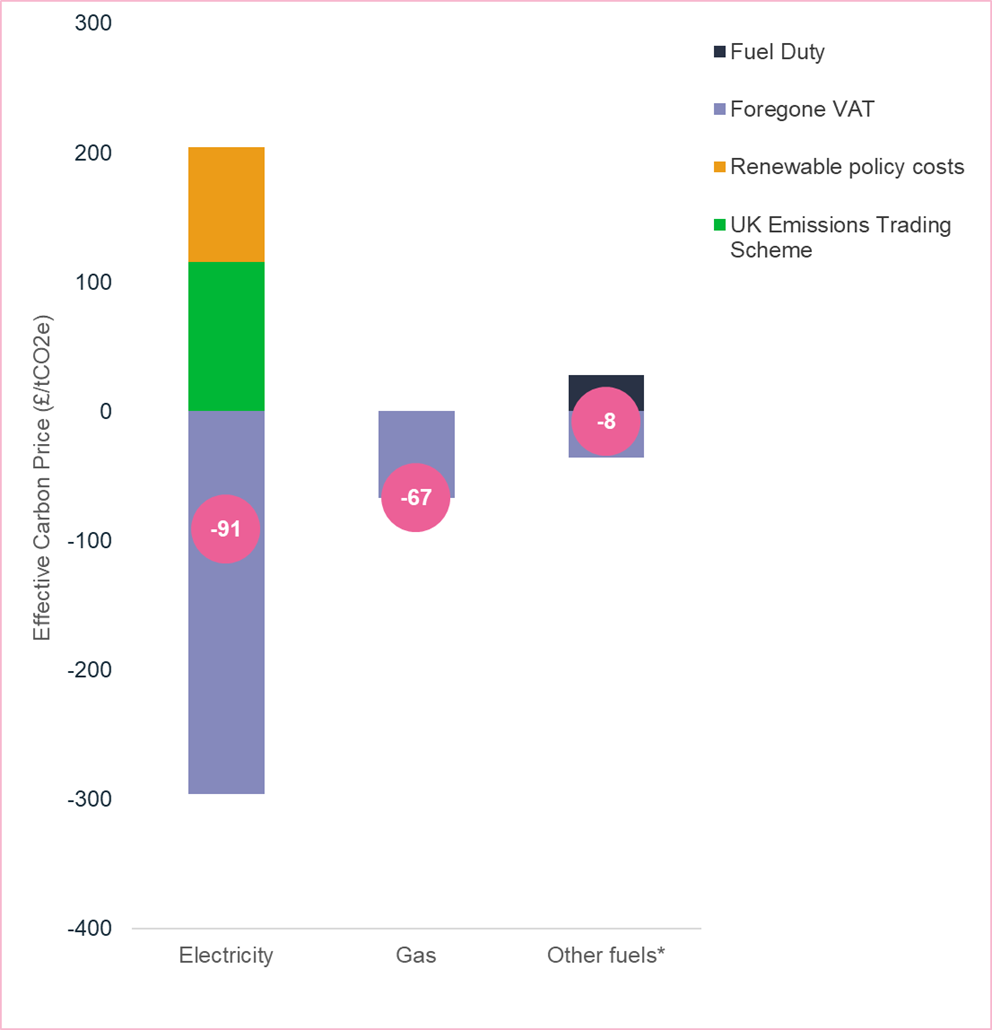
Figure 1: How policies are influencing effective carbon prices of domestic energy sources. The number displayed in the pink circle for each energy source shows its effective carbon price resulting from the combined effect of all policies, including the removal of the Carbon Price Support. *Values for ‘other fuels’ are weighted by their share of other fuels emissions.
But we still need a suitable carbon price to drive the long-term transition to clean heating. A carbon price, when high enough, provides an important price signal to reduce emissions in an economically efficient way. It directly exposes polluters to the cost of the emissions they produce and encourages them to decarbonise. The UK ETS, which operates under the cap-and-trade principle, is the country’s cornerstone carbon pricing policy for driving this change.
The UK ETS could help decarbonise the way we heat our homes if it were phased in over time to cover first natural gas and then other heating fuels. We think the government should use the UK ETS in this way to rebalance electricity and gas prices.
While any use of carbon pricing brings uneven distributional impacts, mitigating them is a political choice that can be achieved through revenue distribution.
It’s clear that scrapping the CPS will reduce bills in the near-term, but is it the best way to help households?
In our latest Innovating to Net Zero report, we recommended the total effective carbon price should be set at a level that incentivises low-carbon flexibility – enabling consumers to help balance the grid by releasing and storing energy in response to peaks and troughs in demand. The revenue generated would then be recycled back to consumers to address distributional impacts.
According to the Institute for Fiscal Studies (IFS), revenue generated by the CPS was forecast to be £200 million in 2028-29.
While the funds could have been used to support low-income households in the near term, due to its low price it’s unlikely to be sufficient in the medium-to long-term. A more sustainable alternative is to place a direct carbon price on heating by extending the UK ETS and directly bringing it in line with electricity from a carbon price perspective.
While this would increase the cost of heating homes using gas, the revenue generated can be recycled back to low-income households, reducing the near-term impact while incentivising the transition to low-carbon heating.
Removing the CPS is a pragmatic step by government to ease the pressure on household bills and simplifies the UK’s carbon pricing landscape, but it’s ultimately a short-term solution.
If the government’s goal is both affordability and decarbonisation, the question is not whether to price carbon to incentivise the transition to clean heating, but where and how to do it more effectively.
Rather than lowering the carbon costs on electricity generation, a more durable approach is to rebalance them. This means bringing gas, including heating, into a stronger and more consistent carbon pricing framework – using the UK ETS – supported by measures to help households manage the impact.
An Energy Systems Catapult thought leadership project, focusing on how the UK can develop an innovation-friendly, economy-wide framework for Net Zero.
Click here for moreFind out more about how Energy Systems Catapult can help you and your teams
Find out more about how Energy Systems Catapult can help you