Comment by James Johnson, Head of Regional Programme at the North West Net Zero Hub, and Dr Anna Stegman, Local Energy Transition Advisor at Energy Systems Catapult
The clock is ticking. Local authorities have just two years before Ofgem publishes a single, joined-up investment plan for energy networks across Britain’s 11 regions.
Regional Strategic Energy Plans (RESPs) are a chance to shape investments in power, gas and hydrogen networks based on local needs and a major opportunity for local government to influence network investment in their region.
But our Ready for RESP programme has found real concerns about delivering it. Local authorities need time, resources and support to engage properly and unleash clean energy innovation – or they risk missing out on the growth and opportunities RESP offers.
Over the past year, we’ve spoken to local authorities across England, from small rural districts to mayoral combined authorities, as well as network operators, to better understand the challenges they face.
Here’s what we’ve learned so far, what needs to change and some resources to help you get started.
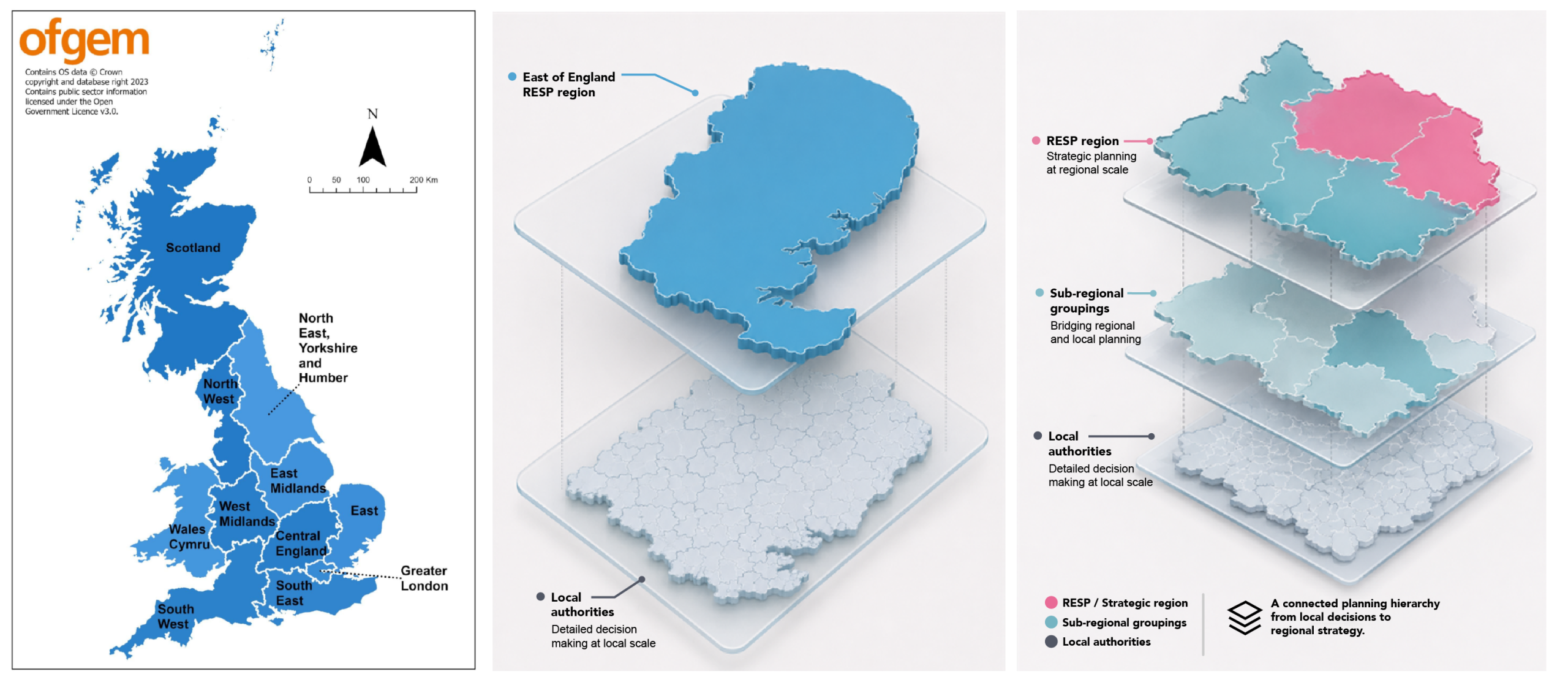
From left to right: Britain’s 11 RESP regions and nations (image credit: Ofgem) with illustrative examples of how these regions break down into local authorities and RESP working groups
Local authorities are already stretched
A council’s first priority is meeting its statutory duties, and resources for that are already stretched thin.
RESP isn’t a legal obligation, but it’s a route to unlocking investment in growth and clean energy. That means getting senior leaders on board, freeing up internal resources, building understanding across departments and cutting the manual effort needed to gather data.
Most councils we spoke to are already juggling many major planning work including Spatial Development Strategies (SDS) and local government reorganisation.
For help understanding how a local energy plan can inform, and be informed, by your existing policy documents, read our guide on local decarbonisation planning.
There’s also a messaging problem.
Ofgem and the Department for Energy Security and Net Zero (DESNZ), welcome councils linking energy system investment with their housing, growth, transport and heat network plans.
But RESP isn’t being promoted in the same way by other departments like the Ministry for Housing Communities and Local Government (MHCLG), Department of Transport (DfT) or bodies such as Homes England.
We know NESO’s RESP team is working to fix this as part of a wider push to get council’s ready for the investment coming from the Clean Power 2030 Action Plan and the Clean Energy Superpower Mission.
For now, if you need help assessing renewable energy planning applications, read our guidance for planners.
Grid capacity affects everyone
For many councils, grid constraints are already holding back housing, industry and inward investment – and this will only get worse as we electrify heat and transport.
RESP promises to bring investment forward so networks and critical infrastructure are ready before demand hits. That covers everything from carbon capture and hydrogen supply to the networks feeding into national Strategic Spatial Energy Planning – a big opportunity for UK innovation.
But RESP will only succeed if it balances national assumptions with local evidence including growth plans, rural investment needs and major developments. Distribution Network Operators (DNOs) already face this challenge – weighing up the evidence and making a best guess about where investment matters most.
RESP gives councils a stronger voice. But areas without strong evidence – especially those lacking local area energy plans – risk being overlooked even when they have promising projects.
Do the right people have time to take part in RESP?
Councils told us, again and again, that only a handful of their officers have the specialist skills needed, and the funding for evidence gathering and stakeholder engagement is tight.
Many said they’re “muddling through” on personal initiative rather than organisational capacity.
Local Net Zero Hubs have helped fill that gap. Without them, many wouldn’t have submitted evidence for the first Transitional Regional Energy Strategic Plans (tRESP).
As RESP’s methodology is finalised, councils need to gather local data, coordinate their teams and work with unfamiliar technical models. With time running out, here’s our guide on local government resourcing for RESP.
Without support, participation will vary, weakening the place-based ambition that RESP is meant to deliver.
Thankfully, NESO is developing a national support framework with clearer data requirements, due later this year, and each region will have a dedicated team working with councils.
Councils want consistent evidence, fast
Local Area Energy Plans (LAEPs) came up time and again. They give councils a shared evidence base, make energy planning tangible for leadership, and bring planning, policy and delivery teams together.
More than 40% of local authorities now have, or are developing, a LAEP, but they vary hugely in methodology and detail so some are more useful for RESP than others.
If you’re asking yourself whether NESO will fund or mandate LAEPs for RESP the answer is “no”. But its coming support framework should improve their standardisation and make datasets available.
But static PDFs and jargon heavy dashboards won’t cut it. That’s why we’re improving LAEPs, including our first-of-a-kind digital LAEP with Leicestershire County Council.
The Local Net Zero Hubs, with DESNZ, have also published guidance and a data playbook to standardise how LAEPs are commissioned.
What next?
To build on this momentum and strengthen the link between RESP and local energy planning, we recommend:
- Government departments beyond DESNZ promote RESP to councils through the right messaging;
- NESO engages with councils in a way that respects their limited capacity;
- Relevant agencies invest in shared, regularly updated baseline datasets;
- DNOs and local actors align their data, including through Common Planning Assumptions;
- A standard process should set out minimum data for DNOs and RESP, avoiding duplication;
- RESP’s Local Actor support helps councils keen to commit resources to local energy planning;
- Local Authorities have a clear role, with visible use of their data and insights, including from LAEPs.
Get this right and RESP can deliver a more coordinated, democratic and efficient energy transition – one that supports your local ambition and growth.
Work for a local authority and want to learn more about local energy planning? Check out our free, CPD accredited e-learning course here.
And if you’re looking to get started on local and regional energy planning, or keen to discuss the opportunities a digital LAEP could unlock, we’d love to work with you. Email: Anna.Stegman@es.catapult.org.uk
The Ready for RESP programme was funded by DESNZ, led by the North West Net Zero Hub on behalf of all Local Net Zero Hubs in England, and delivered by Energy Systems Catapult. Find out more here.
Are you an innovator?
If you are building solutions for local energy systems, we'd like to hear from you too.
Learn more