Want to know more?
Find out more about how Energy Systems Catapult can help you and your teams
Get in touch
Want to know more?
Find out more about how Energy Systems Catapult can help you
The UK has experienced unprecedented high temperatures this summer. Heatwaves are becoming more common and are getting even hotter. Consumers are increasingly turning to air conditioning (AC), from fixed installs to smaller portable units, in the home, raising the demand for electricity.
We analysed smart meter data from homes in our Living Lab to show how household demand rises with cooling activity and how much domestic solar panels and the energy they generate can offset this. Here’s what energy use looked like between May and August when the UK was experiencing record heatwaves.
Our survey data shows AC adoption within the Living Lab at around 9% nationally, more than double that in the recent RADFutures study estimate. As expected, we see a higher concentration of AC in hotter regions with a potential anomaly in the North West.
Portable AC is especially popular in London, likely reflecting a high proportion of renters with limited space and challenges getting approval from their landlords to install fixed units. Fixed AC is more common overall in the Living Lab, however. These higher adoption rates allow us to glimpse what future UK energy cooling demand might look like.

Summer has historically been a relatively calm time for domestic energy demand. Heating profiles during this time of year remain relatively flat throughout the day, with the usual uptick in the evening. However, very hot and extreme weather can lead to a sustained increase in demand from AC. In particular, portable AC units are energy hungry and not particularly efficient compared to fixed AC.
On the hottest days, we saw homes using AC without solar to power it frequently double their energy use throughout the day and particularly in the evenings when cooling activity would have been at its peak (see Figure 2).
We took weather data from each region of the UK and combined this with homes’ real smart meter data to see when demand lifts through the day.
On the hottest days, we see a rise in consumption all day, with AC likely running from morning to night at maximum intensity. On slightly cooler days, we can still see people switching on their AC as the afternoon approaches and even in the evenings – likely to cool their homes before bedtime.

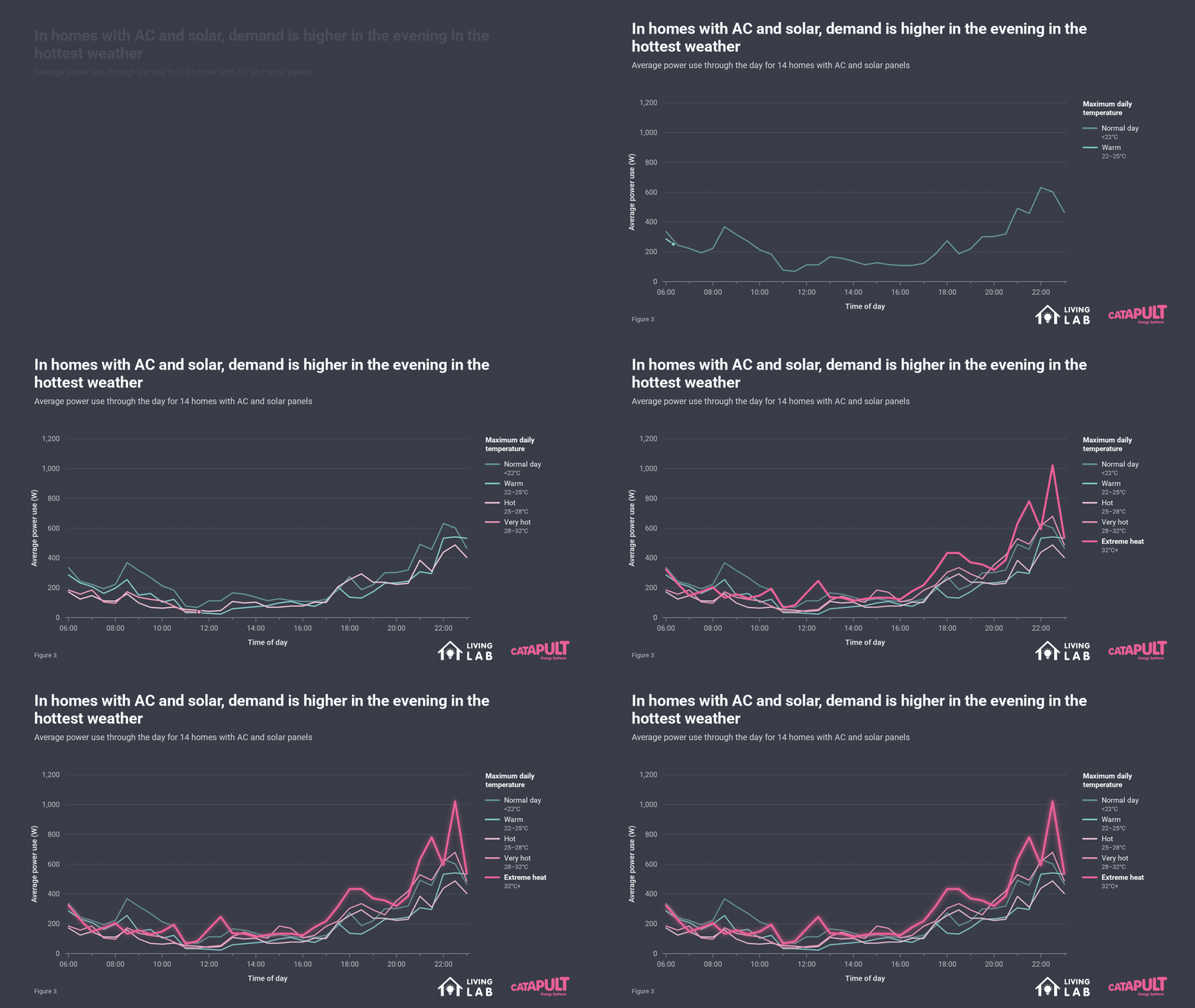
Homes with solar using AC saw their energy use remain largely unaffected until 6pm onwards as the sun goes down and their batteries are depleted (see Figure 3).
Homes with cooling and no solar electricity generation saw a significant increase in their daily electricity use as days get hotter – it more than doubles during extreme heat (see Figure 4). Homes with solar panels only see an increase during extreme heat, where cooling demand may exceed their solar production.
Surprisingly, homes without AC and solar generation show a decrease in energy use versus normal days. This could be because the occupiers are out the house or reducing other electrical use, decreasing their overall use within the dwelling.

‘Cooling degree days’ allow us to estimate the cooling need across a day based on the mean temperature versus a standard base temperature.
We define cooling degree days (CDD) with a 22°C base temperature. Daily mean temperature is taken as the midpoint of the daily maximum and minimum:
Tmean ≈ (Tmax + Tmin) / 2
CDD = max(0, Tmean − 22°C)
Example: on a day with mean temperature 25°C, CDD = max(0, 25 − 22) = 3 CDD.
Looking at cooling degree days, the effect of temperature on cooling energy demand is very clear (see Figure 5).

On a hot summer’s day (mean of 25°C, around 3 CDD), homes with AC and no solar generation are using on average an extra 3 kWh. On extreme heat days where mean temperatures are around 28°C, these same homes used on average an extra 9 kWh of electricity, more than doubling their baseline consumption.
Solar generation, coupled with battery storage, typically reduces AC grid imports by 65%. However, late evening/early night grid imports can still be high with solar generation dropping and batteries depleted. Technologies such as solar PV and batteries come with many installation barriers dependant on the sort of dwelling. We also see that homes with portable AC are less likely to have these complementing low-carbon technologies compared with homes with fixed AC.
Heat-related health risks are rising, so more people will turn to AC to keep cool. Fixed units cost more, need the right space and usually a certified installer. That may push people towards cheaper plug-in portable units, which use more energy to do the same job.
Solar panels and batteries reduce the impact, but don’t remove it. Homes with AC and solar still see demand peak in the evening, when solar generation drops off and batteries run down.
So it’s worth thinking now about how to encourage more efficient types of cooling. A reversible heat pump heats the home in winter as well as cooling it in summer, and can be run while solar panels are generating. That’s easier on the grid than a portable unit running all evening. But support for heat pumps mostly goes to owner-occupiers, not the renters who are most likely to buy portable units.
Networks also need to plan for summer, not just winter. Cooling demand peaks when hot weather reduces how much power cables and transformers can carry. And it may not show up in the same places as heat pumps, so those areas may not get the network upgrades that come with them.
Understanding how these patterns play out in real homes is exactly why the Living Lab exists – if you’re working on cooling technologies, network planning, or want to trial something with real households, get in touch with us.
Whether you’re a policymaker seeking evidence on how electrification is changing demand, a network operator planning for clustered LCT loads, a researcher studying consumer behaviour, or a product developer wanting to test innovations with real people in real homes, the Living Lab can help.
Get in touchFind out more about how Energy Systems Catapult can help you and your teams
Find out more about how Energy Systems Catapult can help you