Richard Leach, Senior Local Energy Transition Advisor, tells Utility Week how new approaches are helping organisations identify and prioritise investable opportunities at every scale
The UK is entering a new phase of regional energy investment, with unprecedented levels of funding set to flow into local areas. The winners – from councils and local authorities to innovators and investors – won’t be those who understand just the policies but those who tap into the underlying data to tease out project and investment opportunities.
In recent months, we’ve seen major policy announcements starting to reshape the UK’s local energy landscape – a shift that Andy Burnham’s pledge to devolve powers could further strengthen, making place-based collaboration a new operating principle for the country in his pitch for PM.
The Local Power Plan has committed up to £1 billion to support community and locally owned clean energy projects. Meanwhile, the Warm Homes Plan has set aside some £15 billion to double the heating from low-carbon heat networks and upgrade five million homes with insulation, heat pumps and rooftop solar.
Much of the reaction to these schemes has focused on the scale of ambition. But for the local authorities, community groups and innovators we’ve been speaking to the key question they’re asking is how do we spot the actual opportunities that are relevant to me?
What’s up for grabs?

Huge untapped potential: just 20% of schools and under 10% of hospitals currently host solar panels
Both government programmes create substantial but very different opportunities.
The Local Power Plan is set to spark collaboration among local authorities, community energy groups and the private sector. This’ll lead to solar installations across public buildings (including schools, leisure centres, offices and car parks), renewables projects owned by communities or through shared ownership models, and smaller schemes aggregated into investable portfolios.
Local government is central to opening up these public assets and shaping delivery models. While suppliers, developers and installers are critical to forming partnerships, testing innovative technologies and scaling their deployment.
The untapped opportunities here are huge. On solar alone, just 20% of schools and under 10% of hospitals currently host panels.
The Warm Homes Plan is broader in scope, creating a larger and more complex set of opportunities across the built environment.
Coordinated correctly, we should start to see local authorities deliver area-based retrofit programmes. Community organisations can play the role of trusted intermediaries to drive engagement and uptake, potentially working as delivery partners for neighbourhood-scale schemes.
In turn, this should create opportunities for the private sector to scale-out the installation of insulation, heat pumps and solar, offering ‘whole home’ retrofit solutions, and the innovative financing and service models that make them attractive for consumers.
We’re already seeing hints of this taking shape with domestic heat pumps. Companies are integrating grant funding into their commercial offers, advertising “fully funded” or “part-funded” upgrades, signalling a shift towards more consumer-oriented delivery models.
Spotting the opportunities
The challenge most organisations now face is how you identify the specific project opportunities that align with your interests, capabilities, geography and strategy.
Thankfully, recent advances in data and automation are making it a lot easier to spot and prioritise opportunities across any scale. Either by street, neighbourhood, local authority, regionally or nationally.
This fresh perspective allows organisations to generate an ‘investment prospectus’ of potential opportunities tailored to:
- Technology type
- Project size and scale
- Capital costs
- Location-specific data sets including energy network data, socio-demographic data, land or building classifications
Links with LAEPS
Over the past decade, Energy Systems Catapult has been at the forefront of Local Area Energy Planning (LAEP) – but we’re now seeing significant progress in both methodology and digitalisation.
The latest data-driven and digitalised LAEPs, identify and prioirtise the hundreds of thousands of potential energy system projects and investment opportunities that are considered as part of the LAEP process.
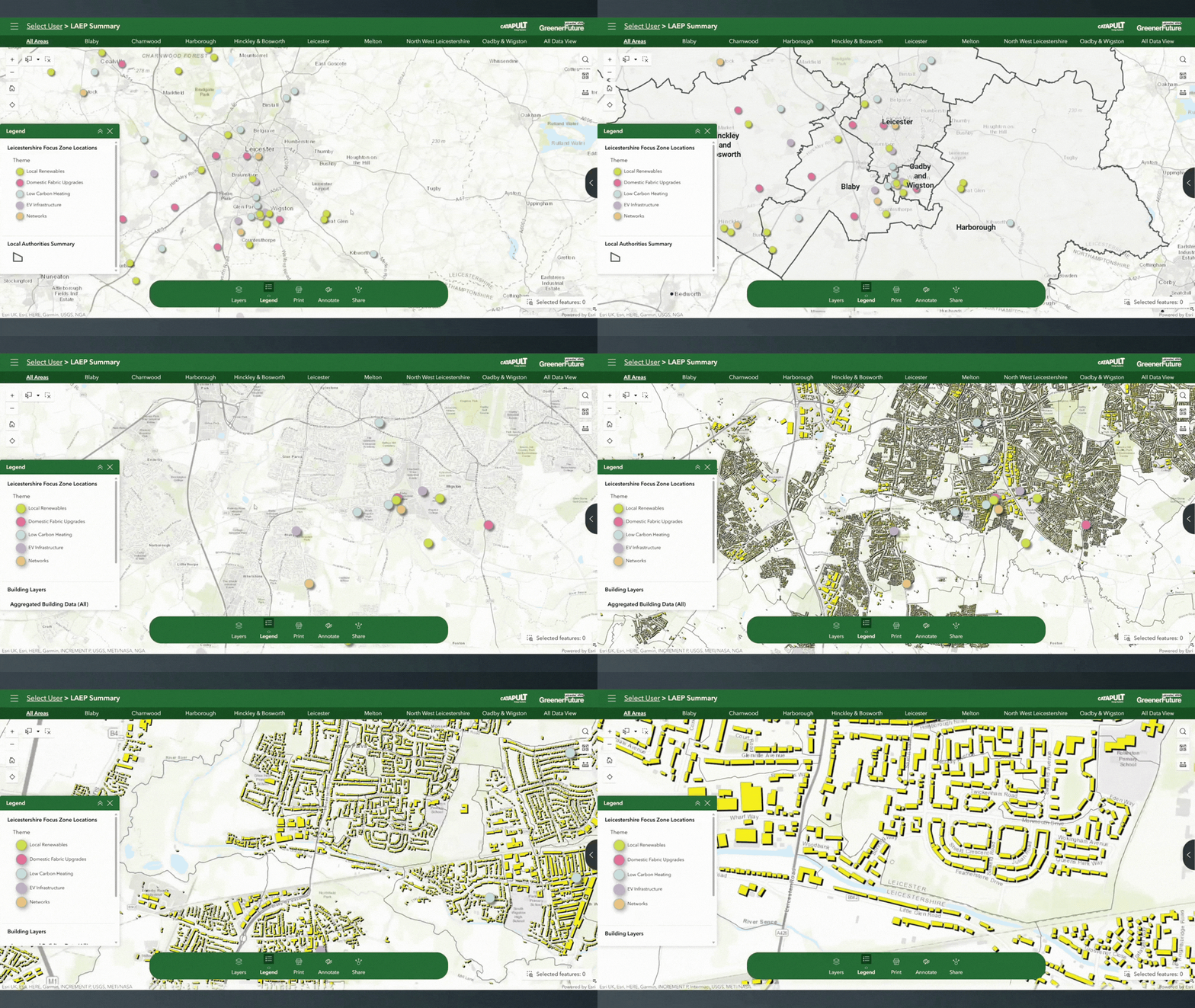
The LAEP Lens tool allows users to explore clean energy project opportunities across Leicestershire
This goes far beyond traditional LAEP reports. While written documents typically summarise the ‘what, where, when and how much,’ the real value lies in the underlying datasets, which contain far richer and more granular opportunities than any static report can show.
The recent GreenerFuture Leicestershire, a £2.5 million Innovate UK-funded demonstrator shows the benefits of this approach.
Its first-of-a-kind digital LAEP used an automated whole energy system approach to assess thousands of scenarios, identifying and prioritising opportunities across Leicestershire – from county to street level.
This digital format allows local government, community energy groups, investors and innovators to understand and search for opportunities (alongside other place-related datasets) aligned to their own criteria.
Users now have the insights to build project pipelines with confidence, knowing that opportunities are all part of a coordinated plan.
Where to start
While having a high-quality LAEP is a strong foundation, it’s not a prerequisite.
There are now organisations, including Energy Systems Catapult, that can rapidly analyse local areas, identify opportunities aligned to specific funding or other project criteria and generate tailored pipelines of opportunities at relatively low cost.
This significantly lowers the barrier for stakeholders to identify where funding may be available from the Local Power and Warm Homes plans, or spot opportunities for attracting investment.
The tools to do this exist now. The challenge is to use them to accelerate the roll out of place-based clean energy schemes, reducing energy bills, boosting energy security, scaling innovative technologies and unlocking economic growth.
This article was originally published in Utility Week. Whatever stage you’re at in planning your clean energy transition, get in touch — we’d love to help you get there. Click on the links below to start a conversation.
Are you an innovator?
If you are building solutions for local energy systems, we'd like to hear from you too.
Learn more