Charging ahead for eHGVs: How to better meet the energy needs of greener trucking
Comment by Will Bonnell, Transport Systems Engineer, and Tobiloba Oyeleke, Graduate Energy Analyst, at Energy Systems Catapult
When electric HGVs hit the grid en masse to recharge, the UK could need the equivalent of three Hinkley Point C nuclear plants running at full capacity to meet demand.
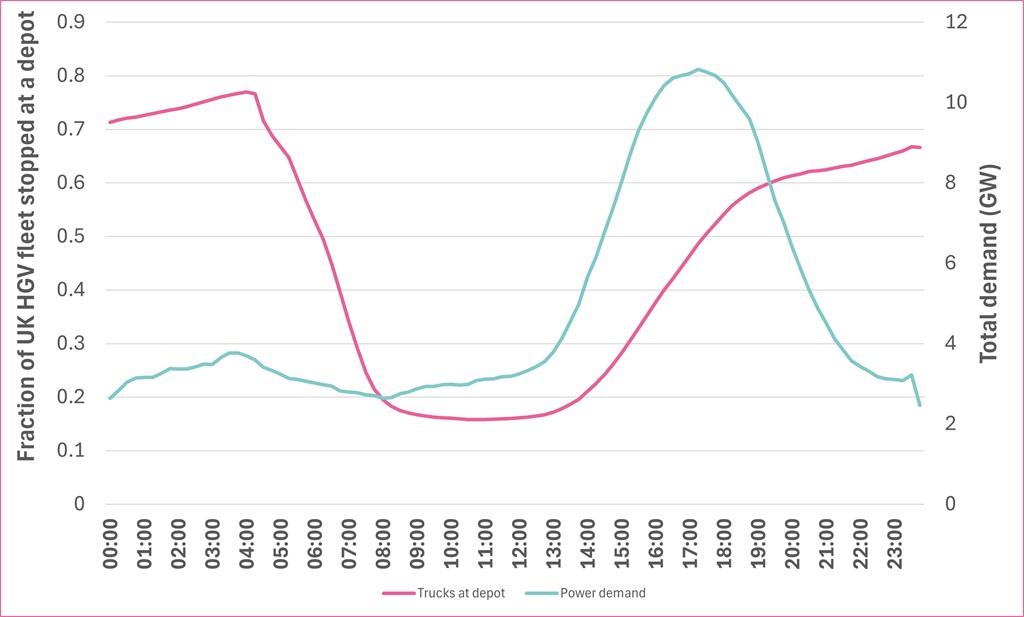
Put another way, our latest modelling of future energy scenarios (see Figure 1) shows that peak power demand from eHGVs in 2050 could climb beyond 10 GW. In itself, that’s a significant challenge. And one that’s more eye-opening when you factor in that this demand from eHGVs is likely to coincide with domestic peak demand around 5pm. That’s when the rest of us, those who aren’t delivering freight around the country, are typically finishing work and turning on our TVs, ovens and kettles.
Oh, and our heat pumps and electric cars.
It’s 2050 after all. If things are going well, we’ll have electrified most of our energy requirements so demand from our homes, businesses and industries will be much higher than they are today.
Figure 1: Total power demand for eHGVs in 2050 may peak at more than 10 GW around 5pm. This would coincide with the current grid peak.
That isn’t to say the situation is gloomy – but that it requires thoughtful planning and energy system design. Fortunately, our future modelling also shows how we can engineer the system and effectively plan our use and charging patterns to flatten those peaks in demand to make the challenge more surmountable.
This modelling comes out of the work we’ve been doing for the eFREIGHT 2030 programme. Supported by consortium partners, we’ve been using our ESME Road Freight and Co-location models to assess national and site-based energy demands for the eHGV sector. In the coming weeks we’ll publish reports outlining the expected impacts on the national energy system and how we can enable systems and sites to integrate eHGV charging infrastructure.
Sign up here to be notified when they are published. For now, let’s delve into some of our initial findings.
Insights from national-scale modelling
In terms of annual energy demand, by 2045 eHGVs could consume more electricity each year than Scotland and Northern Ireland combined.
The heaviest eHGVs could consume about 950 kWh each working day while driving around 600 km. That’s enough energy to power an average UK home for a little over four months.
We need to understand when and where eHGVs are expected to stop because this underpins the scale and location of demand for recharging infrastructure. It can also reveal potential solutions.
By analysing historic fleet data for the largest HGVs, we discovered 68% stop at depots between 8pm and 6am. This is a good opportunity for overnight charging and opens the door for fleets to make infrastructure investment choices that avoid applications to build oversized connections to the grid, which can be expensive and face lengthy delays.
To mitigate peak demands for energy it’s essential that charging behaviour is carefully managed. The modelled demand profile shown in Figure 1 is based on simple charging behaviour. This assumes that eHGVs stopped at a depot begin charging as soon as they arrive and use the maximum available power of 150 kW.
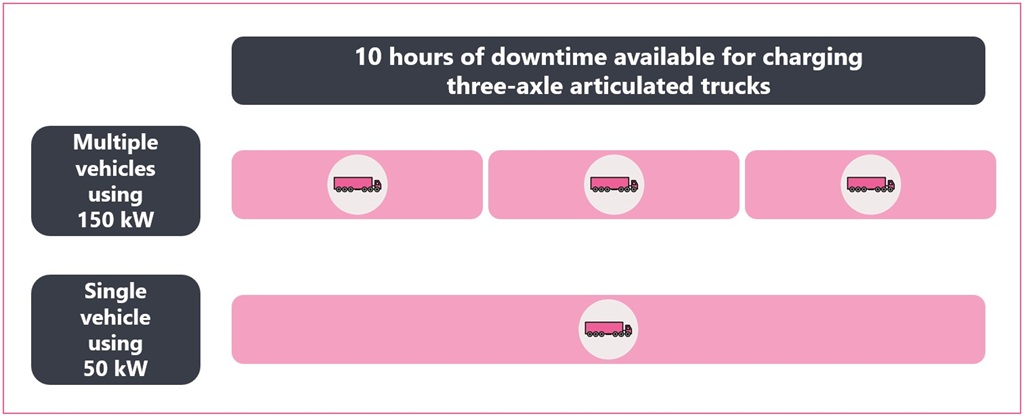
A simple way to flatten peak demand would be reducing the power provided to each eHGV to make better use of its downtime. By plugging into a 150 kW charger, today’s largest eHGVs can fully recharge in 3.5 hours. But given the average overnight downtime is 10 hours, 50 kW could be sufficient in many cases. Alternatively, staggering charging times could have a similar effect.
Figure 2: Fleet operators will need to decide how to balance higher powered charging outlets that can serve many eHGVs or lower powered outlets that would serve fewer, or even one. Larger depots may opt for a mix of differently rated chargers.
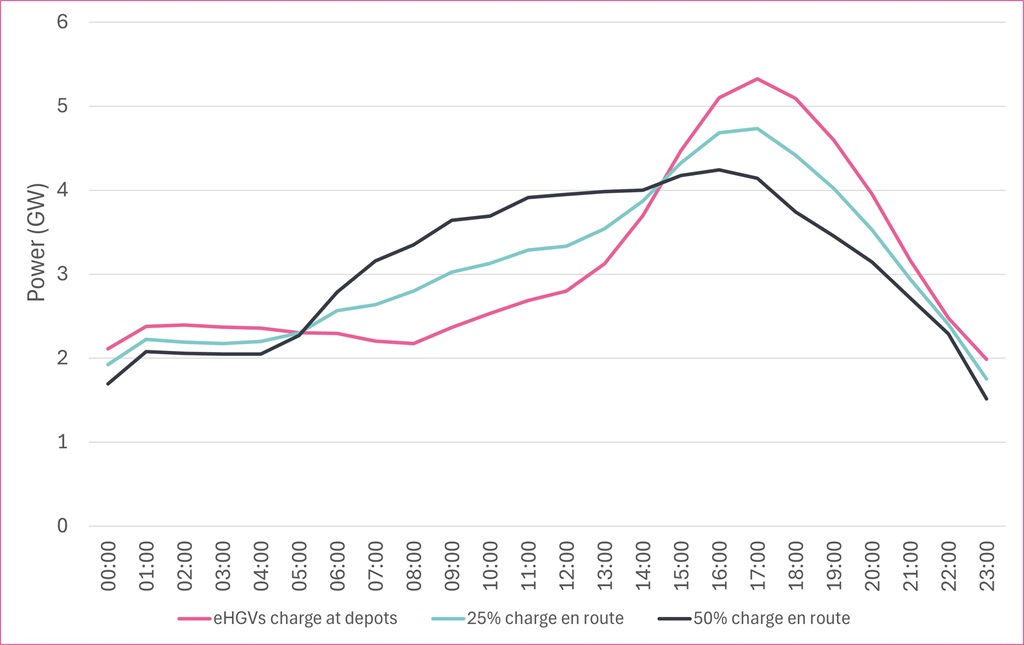
Our modelling shows that peak demand could be reduced by as much as 20% if fleet operators could be encouraged to recharge at shared locations like ports and warehouses where drivers frequently stop during their working day.
This modelled shift in demand can be seen in Figure 3. It compares the daily demand from eHGVs over 40 tonnes when they mainly charge at depots (pink line). It shows how this demand is reduced if we can shift 25% of eHGVs (blue line) and 50% of eHGVs (black line) to charge at shared-access sites throughout the working day.
This is likely to increase operating costs for fleet operators but reduce their upfront capital investments in depot charging infrastructure.
Figure 3: Increasing the proportion of eHGVs over 40 tonnes that rely on shared access charging, such as ports and warehouses, could help reduce the peak demand. This would likely require interventions to make charging at these kinds of locations cheaper.
Vehicle-to-everything (V2X) could also be used to reduce peak demand. Simply put, this involves installing hardware and software in vehicles and charge points so the energy stored in those vehicles can be discharged to the grid to help balance demand from anything else plugged in including homes, businesses, industry and other vehicles.
Our modelling suggests there could be an average of about 50 GWh of energy available for V2X every working day between 4pm and 7pm in 2050.
This could be used to charge those eHGVs getting ready to start a shift during the peak demand. Though it’s important to remember that the eHGVs discharging this energy will also need to recover it. We’d need to make sure doing so avoids producing an even larger peak demand for the eHGV fleet at some other time.
One of the trade-offs for operators providing flexibility for the grid will be a decrease in flexibility for their own operations. Operators will be unable to call a truck into service at a moment’s notice if it’s just sold its power to the grid. However, the impact on fleet operators can be mitigated through careful planning, ensuring that only appropriate eHGVs are selected for V2X. Doing this would require accurate and timely scheduling, further emphasising the importance of good quality data in this sector and potentially providing more opportunities for those companies that can provide and process that data.
We expect that all the solutions discussed above, and more, will be necessary to ensure a robust and rapid transition to eHGVs. How these solutions are implemented at individual depots though will depend on the myriad operational realities of those sites, as we’ll explore in the next section.
Insights from depot-scale modelling
While national averages help set the scale of the challenge, they do not reflect what happens at individual depots. Trucks rarely arrive at depots in a steady pattern. They return in waves creating short bursts of demand that look very different to the smooth national profile in Figure 1.
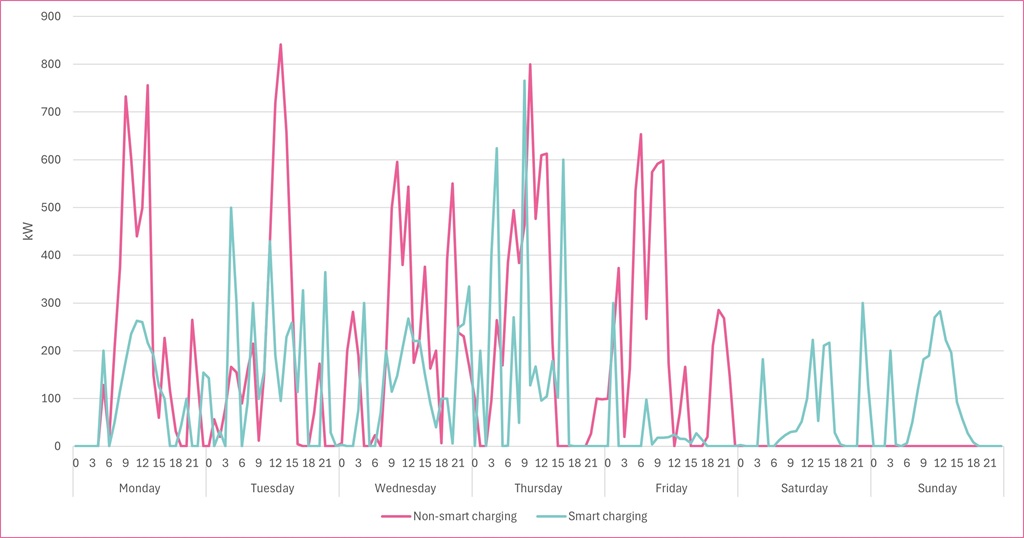
When using non-smart charging, vehicles draw the maximum available power. This often means batteries are fully charged before the truck is needed again and can lead to sharp peaks in electricity demand when eHGVs arrive at the same times.
Smart charging works differently. It adjusts the charging rate to make full use of the available charging time. This helps limit the highest demand peaks without changing vehicle operations and can reduce the level of grid capacity required at the busiest times (see Figure 4).
Figure 4: eHGV charging profiles with and without smart charging at a depot for an example week. Smart charging helps reduce the highest peak demands.
It is important to note that smart charging does not influence when trucks arrive, only how they charge once they are plugged in. In practice, fleet operators may also have the scope to adjust operational factors such as return windows or overnight charging, which could further reduce demand alongside smart charging.
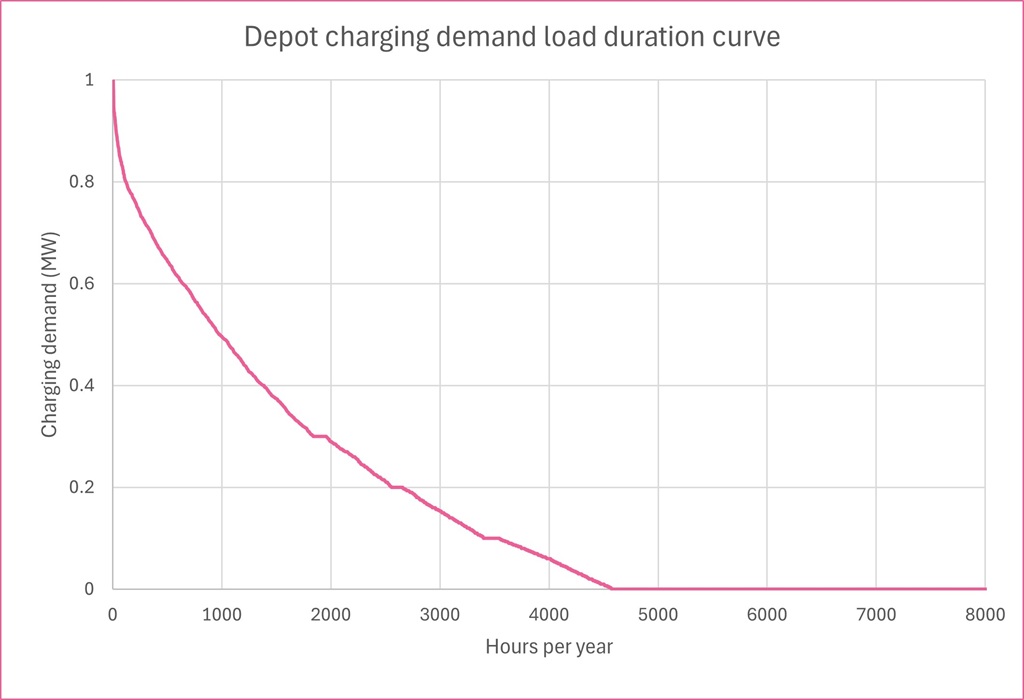
Even with smart charging in place, some demand spikes are hard to avoid. Annual peak demand could be high, but only for a limited time. Figure 5, which represents a depot that has fully transitioned to eHGVs, shows that demand remains well below the highest peak for most of the year.
Figure 5: Modelled annual charging demand profile for a fully electrified depot.
This matters because grid connections are typically sized to meet these peak periods. By using on-site solar and battery storage to ensure those rarer but higher peaks are mitigated, depots can reduce how much power they need from the grid at critical moments. They could then operate on a smaller grid connection. This may also speed up the connection time if the local network is constrained by reducing the need for network reinforcements.
Taken together, these insights show that managing peak demand at depots is about tackling a small number of critical hours rather than reshaping energy use across the entire year.
Used together, these tools can reduce the scale of upgrades needed or support operation on a smaller connection while a larger one is delivered. The right approach will differ by depot, depending on arrival patterns, operational flexibility and timelines for grid upgrades.
Conclusion
Decarbonising heavy goods vehicles means switching to electric models and they’ll need a lot of energy. If unmanaged and unplanned, the demand they create risks coinciding with the overall UK peak.
Fortunately, there are options available to help reduce this peak demand by shifting how, when and where it’s supplied.
It will require careful planning and input from many different stakeholders across the HGV sector and the energy system. Some will have had little prior engagement with each other and therefore it is vital that collaboration is encouraged and accelerated to secure a timely and efficient transition to a zero-emission HGV fleet.
If you want to know more about how the eHGV fleet of the future might impact the wider UK energy system, or what operating eHGVs might look like at an individual depot’s level, be sure to read our upcoming reports.
You can learn more about the eFREIGHT 2030 consortium and register to receive our coming reports here.
Want to know more?
Find out more about how Energy Systems Catapult can help you and your teams
Get in touch
Want to know more?
Find out more about how Energy Systems Catapult can help you and your teams