The Peterborough Accelerated Net Zero (PANZ) project has just closed, producing valuable tools and insights on how local authorities can help accelerate the roll-out of heat pumps across the UK.
Reace Edwards, Senior Consultant for Business Model Innovation at Energy Systems Catapult, and Gemma Driscoll, Project Manager at PECT – an environmental charity working nationally – share what it takes to give consumers the confidence to make the switch.
Reace: A key focus of the PANZ project is enabling rapid, large-scale heat pump rollout in rural parts of Peterborough and other local authority areas. What inspired the decision to focus on rural communities?
Gemma: “Peterborough’s Local Area Energy Plan (LAEP) highlights rural areas as key zones for heat pump deployment. We also know that some of these areas are off the gas grid, so we saw this as an opportunity to decarbonise heating while also supporting residents to reduce long‑term energy costs.”
Reace: How did you identify which rural areas to target in this project?
Gemma: “We carried out a lot of data analysis, looking at demographics, housing, and energy data for the villages surrounding Peterborough city. This included data such as energy performance certificates, fuel poverty and deprivation figures, heating types for houses, housing tenure and property age.
“We then developed dashboards using Microsoft’s Power BI to help us compare those key characteristics across the villages and rural areas we identified.
“Using these insights, we were able to identify seven villages which we felt reflected a good variety of demographic, housing, and heating characteristics. This means our work can be applied across other communities in the future. All these areas were also identified as heat pump focus zones in the LAEP.”
Reace: What did you discover were the biggest hurdles stopping people in rural areas from adopting heat pumps?
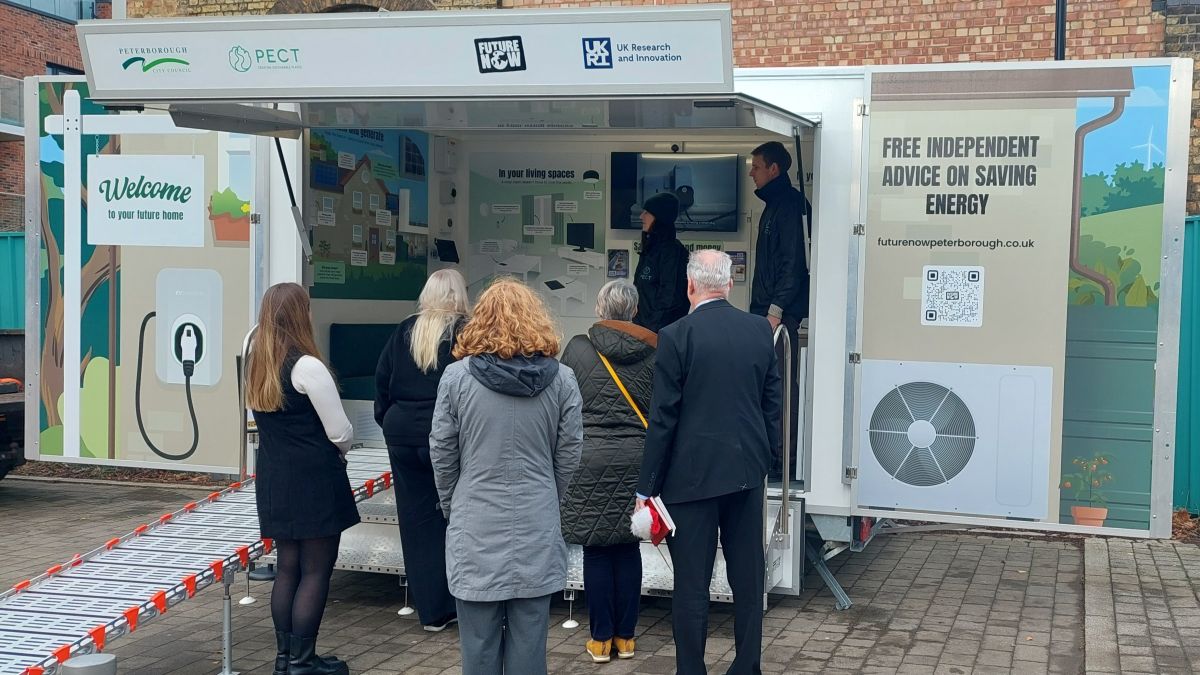
An energy trailer complete with heat pumps, solar panels and EV charging points sparks conversations with the public about what their ‘home of the future’ could look like
Gemma: “A common barrier was cost. People were worried about the upfront price of a heat pump, as well as how long it would take to pay off and what it would mean for their running costs, especially with electricity being more expensive than gas.
“There were some trust issues too. Some residents felt unsure whether heat pumps could keep their homes warm enough, or believed the technology wasn’t yet proven. A perceived lack of skilled, trusted installers came up frequently too.
“As our research encompassed rural areas, we spoke to residents that lived in older, heritage buildings. Some of these residents highlighted challenges around insulating and getting planning consent to upgrade historic and stone-built properties.
“Space was another concern that came up regularly. Fitting an outdoor unit and a hot‑water tank felt like a squeeze for some, especially for those used to a combi boiler without a tank.
“Closely related to this was the question of disruption – many explained they’d only consider installing a heat pump if they were doing this as part of a larger renovation project.
“Residents also weren’t sure how loud the unit might be, or whether it could disturb neighbours or their own time spent outside.”
Reace: What types of engagement helps change people’s minds about heat pumps?
Gemma: “In-person activities were well received. Stalls at community events, heat-pump visits and panel talks all helped residents learn more about the technology. We found that clear, simple communication, paired with interactive engagement, worked really well for opening up honest conversations and helping people move past some of the actual or perceived barriers of heat pumps.
“To make these conversations even more tangible, we developed a life-size heat pump model so people could get a sense of its actual size. We also created a sound box to show just how quiet a heat pump can be compared to familiar household appliances. We also used augmented-reality tools developed by Pump Chic to help residents visualise what a heat pump or hot-water cylinder could look like in their own homes.
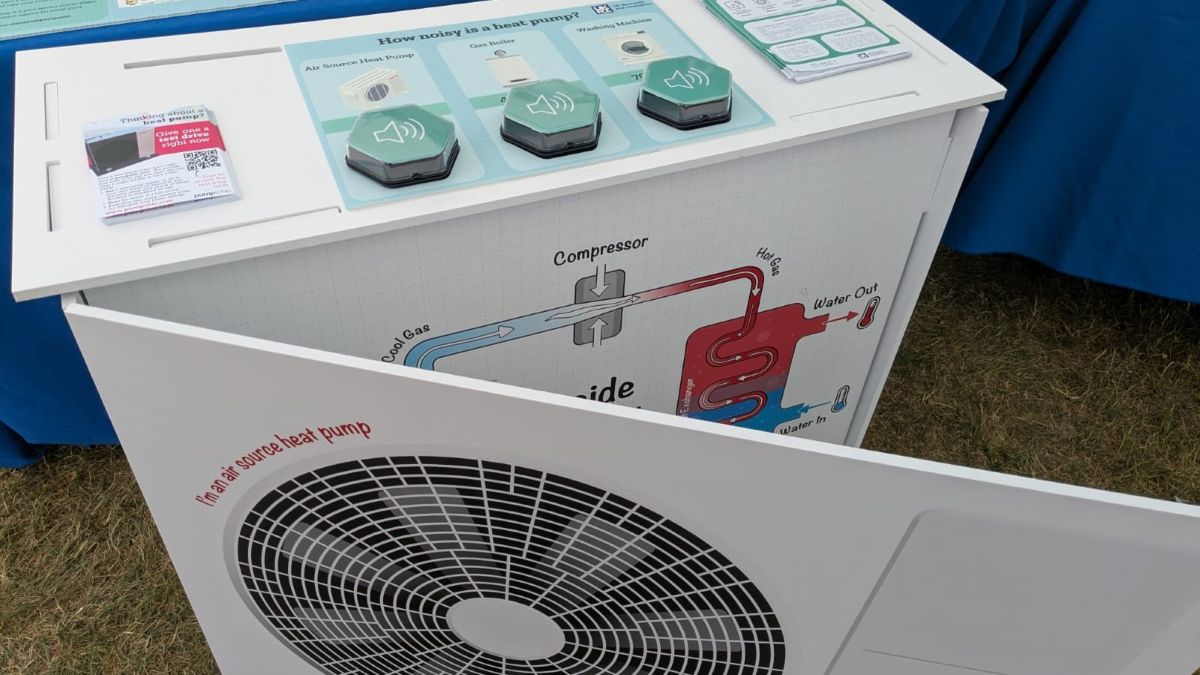
Life-size heat pump models help make conversations more tangible
“Showcasing different energy technologies, both physically and digitally, made a huge difference too. We developed an energy van and an energy trailer that demonstrate a ‘home of the future’, complete with heat pumps, solar panels, EV charging points, insulation and lots more.
“We’ve been taking these out to events to spark conversations and generate interest. Further information on the engagement methods tested through the project can be found in our report, together with funding and business model recommendations from Energy Systems Catapult.”
Reace: what tools are there for consumers who want practical advice on taking the next step?
“I’d recommend the Energy Saving Trust’s Homewise tool, which provides a free energy action plan tailored to your home. This is really useful for residents thinking about how to upgrade their homes.
“We’ve also launched the Future Now website which has lots of straightforward advice about heat pumps and other energy technologies, as well as free access to the Homewise tool. They’re great resources and I’d encourage residents to explore them.”
Gemma: What kinds of business models did you explore to help support heat pump rollout?
Reace: “In total, we looked at ten different business models to encourage heat pump deployment.
“To reduce upfront costs, we explored a self-funded model and also looked at models like Heat Pump Finance, Heat Pump as a Service, Comfort as a Service, and Pay as you Save. These models differ in whether customers pay the upfront cost of the heat pump or spread it through regular payments.
“In some options, the monthly fees also cover added services such as maintenance or guaranteed levels of performance, meaning different models may suit different customers depending on their needs and preferences.”
Gemma: What about business models that help consumers reduce the running costs of a heat pump?
Reace: “We looked at models that incentivise heat pump owners to shift their electricity use for home heating during certain peak, or high-cost, time periods, such as heat pump flexibility schemes and smart electricity tariffs.
“We also looked at models that create wider community benefits, such as Community-Owned Renewable Heat, and make it easier to purchase and install a heat pump, like local Retrofit One-Stop Shop.
“All of this research is captured in our report ‘Business models and complementary funding mechanisms to support heat pump deployment’. The report is designed to serve as a practical knowledge base for local authorities.
“For each model, we set out how it works in practice, how value flows between key stakeholders, the primary benefits and risks, and where possible, real-world case studies.”
Gemma: We know financial barriers can be a major issue when it comes to heat pump adoption. What funding mechanisms did you look into to help make heat pumps more accessible?
Reace: “Alongside the business models, we explored a range of funding mechanisms, which span group buying, affordable loan options, property linked finance, community-led investment models and carbon-based funding approaches.
“We also considered what role local authorities could play in enabling the implementation of these mechanisms. In some cases that might mean promoting a scheme through trusted local channels while in other cases it might require a more hands-on approach such as providing initial funding.”
Gemma: Of all the models that you considered, how did you land on a top choice for enabling heat pump deployment, and what made this the clear winner?
Reace: “First, we scored the ten business models against key criteria, including consumer value and accessibility, supply chain readiness, and commercial maturity.
“The six highest scoring models were then taken forward into qualitative research with homeowners, tenants and landlords across Peterborough. This helped us understand what models people found most promising as well as concerns they had.
“The three models that came out ‘on top’ were Heat Pump Finance, Community-Owned Renewable Heat and the Retrofit One Stop Shop.
“After refining those three models based on the consumer feedback, we then tested them with the supply chain, with Peterborough City Council, and through further quantitative consumer research, which surveyed almost 2,000 participants.
“When we pulled together all the insights from these activities, the Retrofit One Stop Shop model showed strongest potential to accelerate heat pump deployment because it helps overcome many of the barriers you identified earlier. It can also be delivered in combination with some of the funding mechanisms we explored to further drive uptake.
“I’d encourage local authorities to read our Consumer attitudes and uptake summary report for a deeper dive into the quantitative consumer research findings.”
Gemma: For those who might not be familiar, what’s a Retrofit One Stop Shop model and how does it help tackle some of the key challenges for heat pump adoption?
Reace: “In a nutshell, a Retrofit One Stop Shop is an integrated service that gives customers a streamlined, end‑to‑end route through their home energy retrofit, including heat pump installation. The whole idea is to make the process simpler, clearer, and more reliable, cutting through the confusion and uncertainty that often stops people from taking action in the first place.
“A Retrofit One Stop Shop can offer a wide range of products and services. A lot of it starts with education and guidance – giving people clear, trustworthy information through things like videos and simple guides that explain different retrofit options, the technologies involved, and what funding support might be available.
“From there, a One Stop Shop offers early-stage home assessments. This could be an online tool, or an in‑person visit to give people a high‑level view of what might be possible in their home.
“For those ready to go further, full home retrofit plans involve a detailed survey, some modelling work, and tailored advice from a retrofit specialist to create a personalised, step‑by‑step plan for the property.
“Some One Stop Shops also provide project coordination, where a coordinator manages the whole retrofit process. They take on activities such as planning timelines, liaising with installers and contractors, checking quality, resolving issues and making sure everything runs smoothly from start to finish.
“And increasingly, One Stop Shops are exploring ways to help customers after installation too, ensuring the retrofit measures deliver long‑term value and everything works as intended.”
Gemma: How can local authorities best deliver these One Stop Shop services?

Further information on the engagement methods tested during the project can be found in the project report
Reace: “Many of these services can be offered online or through the types of face-to-face engagements that you discussed earlier. Either way, they help address the concerns customers face when it comes to heat pumps.
“Of course, not every Retrofit OSS looks the same. They vary in terms of scope and in the services they offer. Our Go-to-Market report sets out what a local Retrofit One Stop Shop could look like in Peterborough. It covers the current landscape of providers, how different services address customer pain points, which segments to target first, and the partnership options available for local authorities.
“While the report is grounded in the Peterborough context, the insights provide clear direction for other local authorities who are looking to scale up low-carbon heating through local retrofit delivery models.”
Interested in finding out more? Head over to the PANZ project page for resources on business models, funding mechanisms, small-scale heat networks and considerations for setting up a One Stop Shop. Find out more about community engagement mechanisms to support heat pump delivery here.