Manchesterism: Why the UK's energy transition will be won place by place

Comment by Richard Halsey, Innovation Director, Energy Systems Catapult and Chair of the GMCA 5 Year Environment Plan Low Carbon Challenge Group
For a man often dubbed the “King of the North”, Andy Burnham’s latest big idea is surprisingly unassuming.
“Manchesterism” ironically isn’t really about Manchester.
At its heart is a simple proposition: that Britain’s future prosperity will come not from increasingly centralised decision-making, but from giving places the power, confidence and long-term certainty to shape their own future.
Growth, Burnham argues, happens when decisions are made closer to the people and communities that are ultimately affected by it. Whether you agree with the politics or not, it’s hard to ignore the direction of travel.
From English devolution and Mayors to Local Growth Plans and mission-led government, Whitehall is asking places to take greater responsibility for delivering national priorities. Economic growth. Housing. Transport. Net Zero.
The question is no longer whether places should lead.
It’s whether they’re equipped to.
At Energy Systems Catapult, we’ve spent the best part of a decade working alongside cities, regions and government as they grapple with one of the biggest challenges they’ll ever face: turning ambitious Net Zero targets into practical, investable programmes. This work has also created fertile ground for innovation, opening routes to market for a growing ecosystem of clean tech scale-ups building a cleaner, more flexible and secure energy system.
We’ve learnt that the places making the fastest progress aren’t necessarily those with the biggest budgets. They’re the ones that combine clear political leadership with robust evidence, long-term planning and strong local partnerships. Leadership provides the direction; evidence gives people the confidence to act.
Few places demonstrate that better than Greater Manchester. And it has always had a habit of writing its own story.
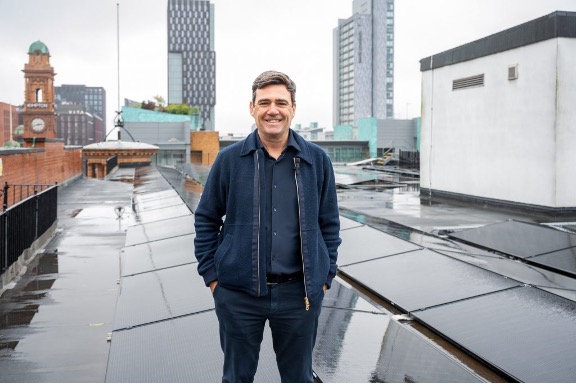
Image credit: Solid Ground / The Tootal Buildings
It helped power the Industrial Revolution. It reinvented itself after industrial decline. It became one of the UK’s strongest examples of devolved leadership long before devolution became fashionable, with its economy surpassing the £100 billion mark in 2026, growing by 28% since devolution in 2015.
“I want more world beating British manufacturers and service providers at the frontier of new technology” – Andy Burnham
Its approach to the energy transition follows the same pattern.
Long before place-based policymaking became part of the national conversation, Greater Manchester recognised that achieving Net Zero would require more than national targets and individual technology projects. It needed a coordinated local plan that connected energy, transport, housing, infrastructure and investment into a single picture.
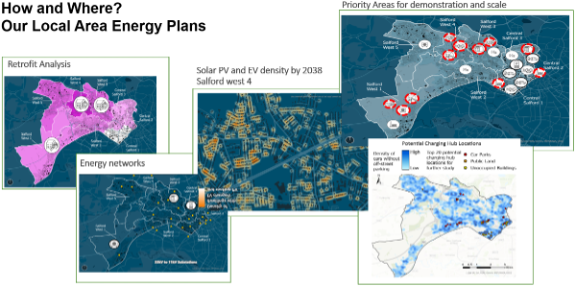
Working alongside Greater Manchester Combined Authority, we helped develop and pilot the Local Area Energy Planning (LAEP) methodology in Bury before supporting its rollout across all ten boroughs. Today, Greater Manchester remains the first city region in the country to adopt LAEPs at that scale.
Our £17.2 million Unlocking Clean Energy in Greater Manchester programme helped deliver renewable energy projects across the city region while developing new ways of financing and scaling local energy infrastructure.
This programme supported the deployment of around 10 MW of renewable generation across public-sector sites, alongside battery storage, EV charging infrastructure and smart energy systems. Arguably its greatest contribution was not the infrastructure itself but creating replicable models that other regions can adopt. The project developed tools to assess the economic viability of solar assets, guidance on innovative business models and practical approaches to aggregating projects into investable portfolios.
Perhaps that’s what Andy Burnham has understood particularly well. Manchesterism gives people a clear sense of direction. It tells local authorities, businesses, investors and communities, “this is where we’re going.” That clarity matters. It builds momentum, aligns decision-making and makes it easier for organisations to invest their time, money and expertise behind a shared ambition rather than a series of disconnected initiatives. This is an often-missed component of much of the UK’s energy planning, the need for consensus across disparate parties, businesses, systems, and areas.
Through our InSite programme, Energy Systems Catapult worked with GMCA to create one of the most comprehensive public sector estate datasets in the UK. The project mapped more than 4,000 public buildings and developed spatial tools that enabled local partners to identify clusters of opportunity and prioritise investment.
Rather than asking broad questions about decarbonisation, decision-makers could pinpoint where heat networks might work, which buildings were suitable for solar deployment, where public sector retrofit should be prioritised and how projects could be bundled together to attract investment.
There’s a payoff for innovators too. When a city region can point to a mapped estate, agreed priorities and aggregated portfolios, Net Zero ambition becomes a visible pipeline of demand. Heat networks, retrofit, solar, storage and smart systems stop being possibilities and become procurable projects that clean tech businesses can build against.
That evidence base helped support the development of Greater Manchester’s Net Zero Accelerator programme, backed by £6.2 million from the Department for Energy Security and Net Zero, which is helping bring forward portfolios of projects at a scale attractive to investors.
The opportunity now isn’t for every region to copy Manchester. Burnham’s speech called for “good growth in every British postcode” and for all regions to develop their own version of Manchesterism.
It’s to apply the same principles in ways that reflect local strengths and ambitions: clear leadership, shared evidence and a long-term commitment to delivery.
At Energy Systems Catapult, we’ve been fortunate to work alongside Greater Manchester throughout much of this journey, and with places across the UK facing similar challenges.
As more regions begin shaping their own approach to clean growth and the energy transition, we’d welcome the opportunity to share what we’ve learnt and explore what that could mean for your place.
If you are building solutions for local energy systems, we'd like to hear from you too.
Learn more