Want to know more?
Find out more about how Energy Systems Catapult can help you and your teams
Get in touch
Want to know more?
Find out more about how Energy Systems Catapult can help you
Nusku solves the biggest practical blocker to heat pump rollout in the UK: most homes aren’t set up for a conventional heat pump retrofit without major internal work. This includes cylinder space, pipework changes, resident disruption, lengthy installation times and high cost.
This creates slow delivery, high dropout rates after a survey or quote, and is a poor fit for “boiler breakdown” replacements – exactly when households have to make fast decisions.
It matters for the energy system too because those friction points translate directly into a systemic failure to decarbonise heat at scale.
We’ve developed a solution to overcome these problems. We’ve combined a water cylinder with a heat pump in a single outdoor unit, meaning it’s significantly quicker and easier to install than traditional heat pumps.
By making installs faster, more repeatable and less disruptive, we’re able to unlock volume by making more homes viable with the same installer workforce, while also protecting consumers through shorter disruption and fewer in-home works.
At the same time, lower installation costs help reduce the subsidy required per home and improve programme economics. A standardised, connected platform also supports remote monitoring, proactive maintenance and future flexibility.
In short, we’re turning heat pump deployment from a bespoke construction project into a repeatable product install, which is critical if electrified heat is going to scale fast enough to meet grid and decarbonisation goals.
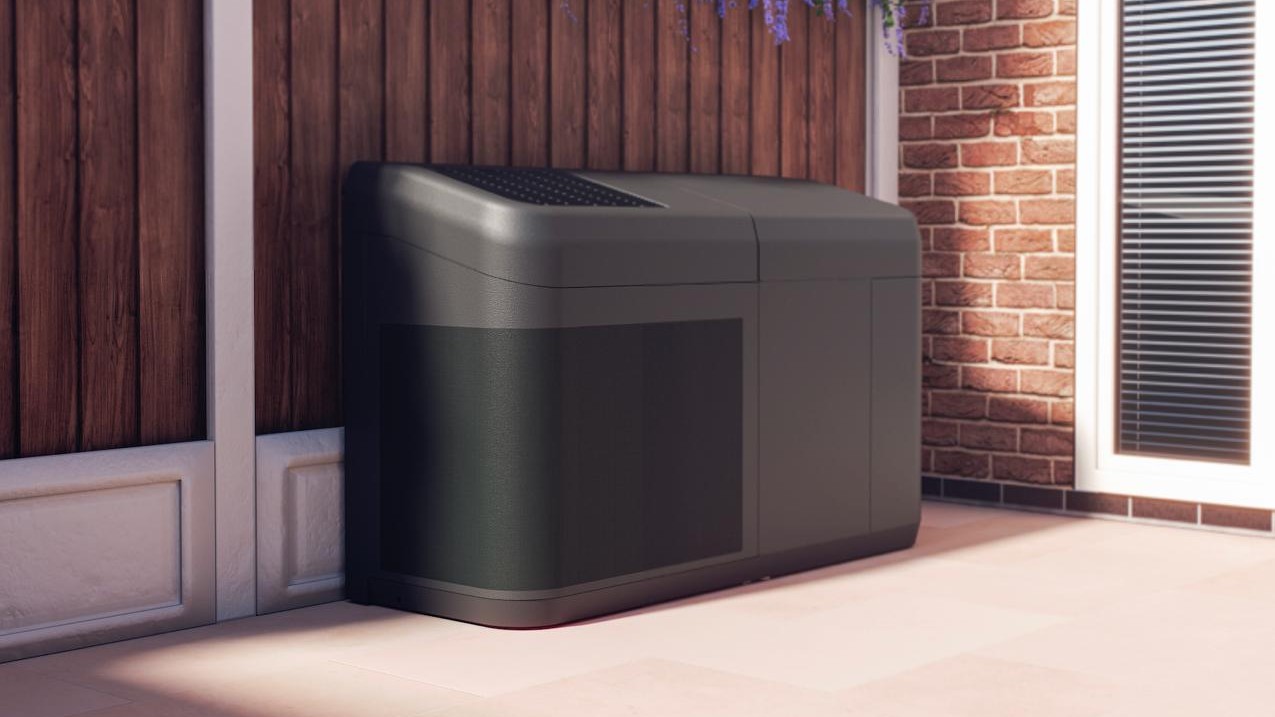
Nusku has combined a water cylinder with a heat pump in a single outdoor unit,
meaning it’s significantly quicker and easier to install than traditional heat pumps
The biggest flexibility opportunity is turning heat into a controllable, grid-friendly load without the resident noticing, especially in social housing portfolios where you can deploy at scale.
This breaks down into four key areas. Firstly, there is ‘thermal battery’ shifting, which is a low-risk and immediate way of using the home’s hot water and space-heating thermal mass to pre-heat in cheap, low-carbon periods and then coast through the peaks.
Even modest shifting across thousands of homes becomes meaningful. It helps avoid peak demand from 4pm to 7pm, soak up midday wind and solar generation, and reduce constraint costs and balancing actions.
Alongside this, portfolio-level control is where the value really starts to build. While a single home doesn’t earn much, a landlord or supplier controlling hundreds to thousands of devices can participate in demand flexibility services, support local constraint management, and reduce supplier peak and imbalance risk.
This is where standardised installs and telemetry really matter, providing predictable behaviour and reliable dispatch at scale.
There is also a significant opportunity in making flexibility work for low income and vulnerable households.
In social housing, the most meaningful form of flexibility is cost protection – maintaining comfort while reducing peak-time consumption and bill volatility. When control is aligned with safeguards such as comfort guarantees, opt-outs and clear rules, it becomes possible to include households that are typically excluded from flexibility markets.
Finally, the longer-term opportunity is to make flexibility a default feature of heat replacement rather than an optional add-on.
Using standard hardware, combined with remote diagnostics and control, creates a scalable platform for suppliers and landlords to monetise, and for the grid to trust.
Taken together, aggregated, comfort-constrained heat shifting represents the biggest near-term opportunity. This is because it’s widely applicable, relatively low cost and scales naturally with deployment.
The biggest challenge has been crossing the ‘hardware scale-up gap’ in the UK: getting enough investment to fund certification, inventory and manufacturing ramp when many UK investors are cautious on capital-intensive hardware.
That slows down deployment even when customer pull exists. Without committed capital you can’t build stock, lock in long-lead components, or stand-up repeatable assembly.
In parallel, building a resilient UK supply chain has been harder than expected. This includes qualifying suppliers, agreeing terms, and making sure capacity can scale quickly while keeping costs down and maintaining traceability for certification.
On the product side, integrating the heat pump and hot-water storage into a single outdoor unit has created significant technical complexity. There’s thermal management, packaging, safety, acoustics, controls, servicing access and performance across seasons. As a result, a lot of effort goes into proving reliability and manufacturability, not just making it work in a lab.
We joined the GridFlex programme to ensure our heat pump is not just easy to install, but a truly grid-friendly asset that can operate in homes for 20+ years.
That means responding to flexibility signals, integrating with home energy systems, and supporting a lower-cost, lower-carbon electricity system over its lifetime.
The programme has helped us validate this in real-world conditions and align with emerging market mechanisms. This is critical to unlocking large-scale deployment across social housing and the mass market.
We’re focused on product certification and customer evaluation ahead of commencing manufacturing.
If you’re an innovator, industry partner or researcher who wants to be part of shaping the UK’s flexible energy future, you can register your interest in the GridFlex programme and stay informed about upcoming opportunities. Sign up here: https://www.digicatapult.org.uk/programmes/programme/gridflex/
Find out more about how Energy Systems Catapult can help you and your teams
Find out more about how Energy Systems Catapult can help you