Want to know more?
Find out more about how Energy Systems Catapult can help you and your teams
Get in touch
Want to know more?
Find out more about how Energy Systems Catapult can help you
As the UK’s energy system becomes decentralised and increasingly interconnected, the West Midlands has become the proving ground for how smarter energy systems can unite energy users, innovators and utilities for clean regional growth.
With the West Midlands Smart Energy Systems Cluster now pulling together partners from across the region, spinning up collaborations and trials, we spoke to Syselek’s Alan Walker about why the company is supporting the cluster, the framework they helped develop so businesses can better plan their shift to cleaner energy, and who else needs to get involved for maximum impact.
At Syselek we help commercial organisations electrify their vehicles, particularly heavy-duty transport.
Energy is becoming critical to these organisations – both in terms of the cost and how they source it. If they make a wrong decision on either, it seriously impacts their competitiveness.
All our customers face this challenge and it’s a difficult space to navigate. There’s a lot of jargon and hype out there.
We represent the voice of medium-sized businesses that are becoming increasingly reliant on energy but don’t have dedicated in-house energy expertise.
That’s why we joined the cluster – to better engage with the wider energy sector and help our customers do the same.
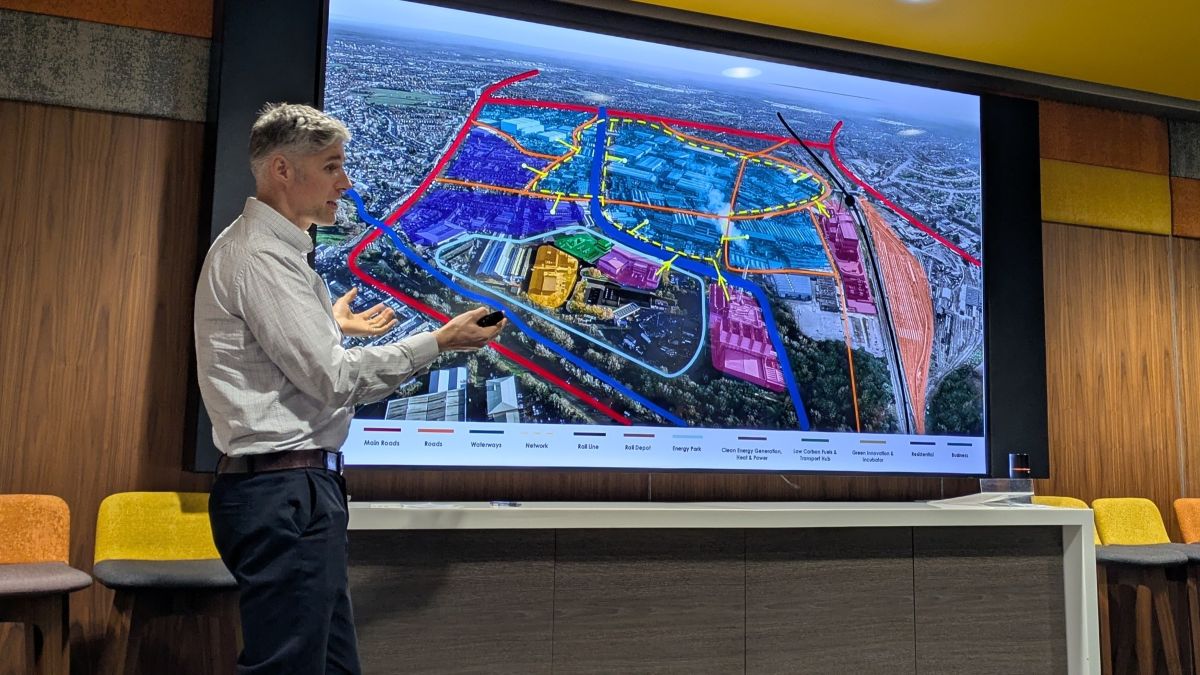
Cluster partners met at a showcase event hosted at Energy Systems Catapult to share progress and opportunities for collaboration
The West Midlands has a very high concentration of businesses that will be impacted by the energy transition. I think it has the second highest density of industrial organisations in the UK.
If the businesses in the region can take advantage of smart energy systems, they’ll stay competitive. If they can’t, businesses fail, jobs are lost and regional growth suffers. The decisions made on energy are one of the first dominos in that chain.
We’re not a hardcore energy sector business and we’re located just on the periphery of the West Midlands region, so in some ways we’re slight outsiders. But that gives us a chance to provide an alternative perspective to the cluster.
We also come from a more fast-paced environment. Automotive development, for example, moves quickly compared to the energy sector. That contrast allows us to highlight cultural issues. The energy sector can be slow, overly-focused on business as usual, and lacking customer orientation.
We see part of our role as challenging that – holding up a mirror and pushing for faster, more customer-focused progress. Others in the cluster bring strong technical solutions. We bring that customer voice and challenge.
It’s about bringing like-minded innovators together under a formalised umbrella to share ideas and collaborate. As a group, we have a much stronger voice – we’re greater than the sum of our parts.
It’s about complementing each other. By combining different technologies and services from across the cluster members – what people often call technology stacking – we can create more complete solutions.
Our customers can see the risks, but they don’t know which direction to take. The energy sector isn’t guiding them effectively or offering products that meet their needs. That gap needs to be addressed.
The cluster helps shine a light on these challenges. Discussions are open and quickly lead to potential solutions from other innovators, which gives everyone exposure to ideas they might not have otherwise come across. It’s also a useful sounding board to test our own ideas and solutions.
The cluster also provides members with visibility of opportunities for project support, including funding. A perfect example is the West Midlands Innovation Programme.
We outlined the challenge to cluster members – that businesses need support to take responsibility for their own energy use and electrification – and that we develop an assessment methodology that businesses can pick up and use themselves.
The region hosts a high concentration of logistics centres, warehousing operations, industrial parks and commercial estates, and while distributed energy resources such as solar generation and battery energy storage systems are maturing, their adoption in commercial hubs is often constrained by commercial, contractual and structural barriers.
We asked for cluster members to put their hands up and help – including Distribution Network Operators, who are stakeholders in the region’s energy ecosystem, and businesses keen to trial and showcase innovations that could be stacked as part of a technology solution. This is what the smart energy systems cluster’s for – to help that collaboration happen.
We then approached freight and logistics businesses whose energy consumption is growing and need help. Not every business can afford to pay a consultant or innovation partner.
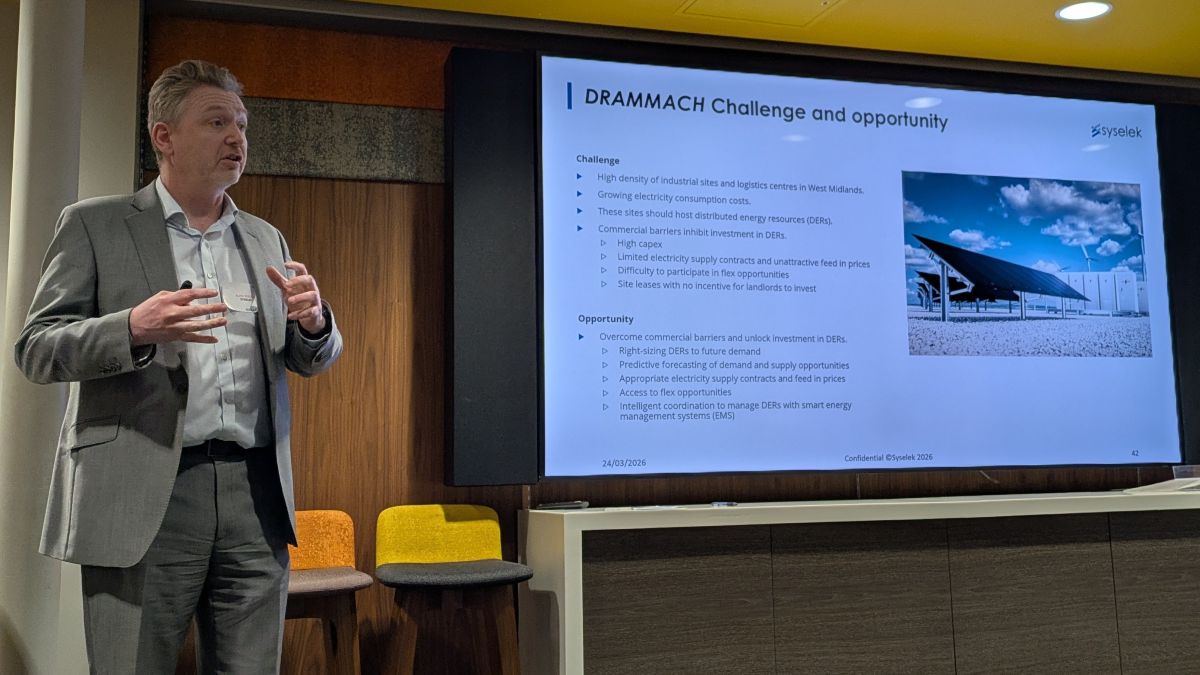
Alan presented the findings of Syselek’s study for the cluster at its recent showcase event
We visited and assessed several business’ sites and found that, while their electricity consumption at their depots and buildings is not particularly high right now, their energy costs are rising, and the coming electrification of their vehicles is set to dramatically increase consumption and costs further.
During these visits, we discovered that some of the premises have small levels of manufacturing and assembly, and others have refrigeration – so there’s a complex mix of energy-use profiles just in this sector alone.
We’ve ended up developing a structured, repeatable workflow for businesses to plan their adoption of distributed energy resources and optimise their energy management systems.
Our analysis confirmed that on-site energy generation can deliver attractive payback periods but critically, the deployment of distributed energy resources needs to be integrated. It needs to combine technical design, tariff optimisation and data transparency.
We also developed shared-benefit commercial models for leased premises.
Finally, we proposed a structured 12-month demonstration project to validate these findings, offering a pathway to regional scale-up.
The region has a portfolio of mechanisms to support businesses in their energy transition including the Local Innovation Partnership Fund, the Supply Chain Transition Programme and the Business Energy Advice Service. We’re hopeful that the businesses we engaged with, and our future customers, will benefit from these opportunities.
For those who want to learn more about our study, there’s more information on our website and a public version of the final report will be published soon.
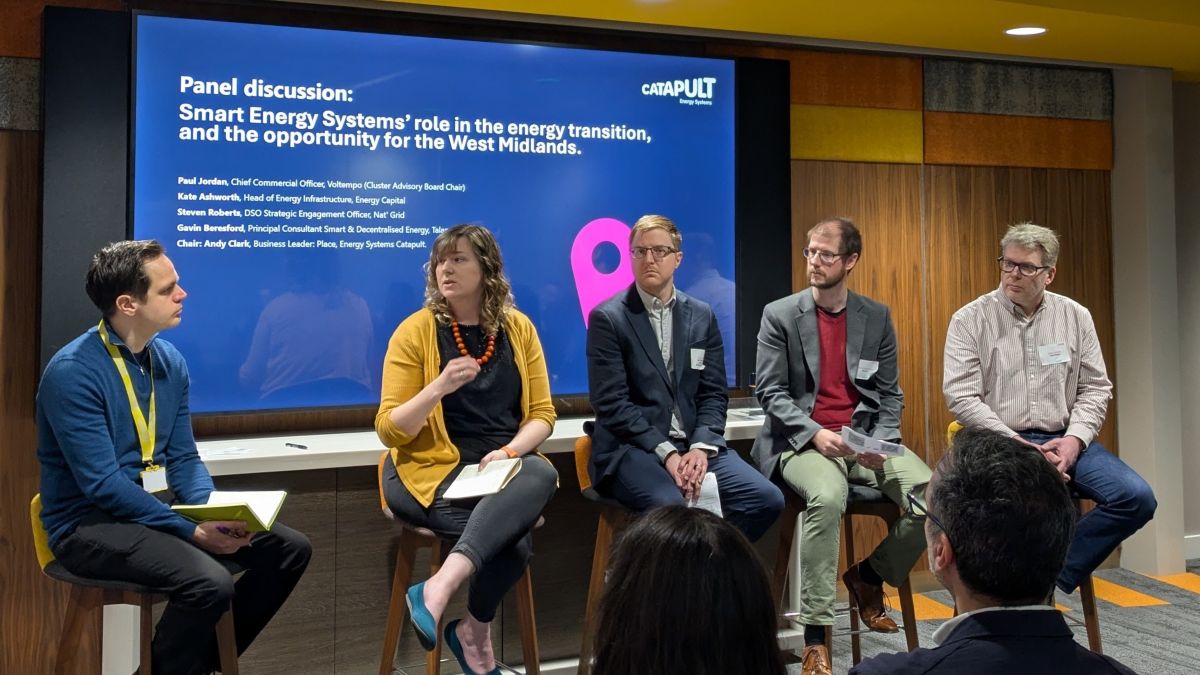
Cluster members discuss the opportunity for smart energy systems in the West Midlands
There was great engagement. It’s an open cluster, and I’d call on local innovators to join us.
To boost momentum, we also need more involvement from what I’d call the problem owners – those businesses whose energy consumption is increasing – who need the support from the suppliers and innovators who have already joined the cluster.
Like Mike Tyson said, everyone’s got a plan until they get punched in the mouth. You’ve got to get your solutions out there. You’ve got to get them in the field and evolve them together with the problem owners.
If you’re an innovator, a problem owner as Alan described it – perhaps a business whose energy use is set to grow or electrify, and are keen to find and test solutions – email: tony.eccott@es.catapult.org.uk
Find out more about how Energy Systems Catapult can help you and your teams
Find out more about how Energy Systems Catapult can help you