- UK innovators have a major opportunity to develop the flexibility technologies needed to smooth out peaks in power and heat demand.
- High use of renewables and nuclear supported by flexibility could reduce energy system costs by at least £70 billion to 2050.
- Flexibility from electric vehicles is especially valuable to the energy system – innovators need to create consumer-friendly propositions to help fulfil its promise.
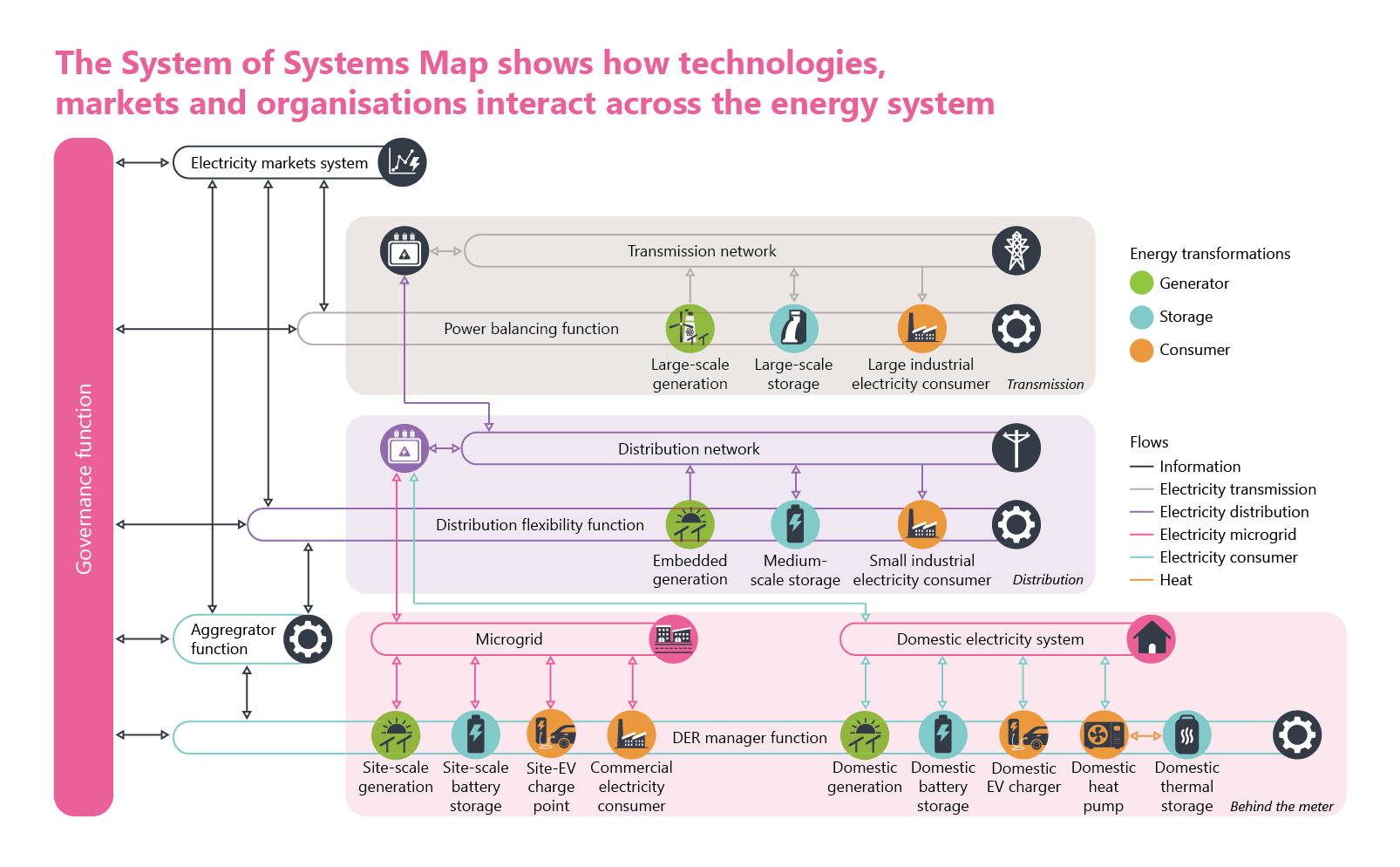
- Energy Systems Catapult has created a new System of Systems Map to help innovators visualise how technologies, markets and organisations interact across the energy system.
New research by Energy Systems Catapult identifies the innovations needed to unlock a £70 billion opportunity for the UK. Achieving the UK government’s Net Zero targets at least cost hinges on the high use of renewables, nuclear, and crucially innovations that enable flexibility1.
Technologies with the potential to provide this flexibility at scale include electric vehicles (EVs), heat stores and static batteries, hydrogen storage, and digital services and consumer propositions that coordinate and control the storage and release of energy in an increasingly decentralised approach.
The Innovating to Net Zero 2026 report modelled and assessed four future scenarios for the energy system to understand how variation in energy generation and demand might evolve depending on uptake of new low carbon and flexible technologies.
It has identified five peaks gaps2 in energy supply and demand that will shape the overall scale and architecture of the UK’s cleaner energy system, and the innovations in flexibility technologies and services needed to manage them and unlock opportunities for UK businesses and consumers. The market for flexibility in Europe is expected to reach €12 billion a year by 2030.
Guy Newey, CEO of Energy Systems Catapult, said:
“Embracing flexibility could help the UK save billions in infrastructure costs – while giving homegrown innovators a platform to scale up and compete globally.”
The findings are based on the Catapult’s internationally peer-reviewed Energy System Modelling Environment models – ESME and ESME Flex – the UK’s leading techno-economic whole system models3. The Catapult has published an interactive dashboard for users to explore its scenarios and the energy systems data behind them4.
The Catapult has also created a System of Systems Map to help innovators visualise how technologies, markets and organisations interact across the energy system and the information flows between them, allowing more effective solutions to be developed to coordinate and enable system operation.
High renewables with flexibility are most cost effective
Driving cost out of the energy system is essential if we are to transition to a cleaner energy system at the pace and scale needed, while maintaining political consensus for action on climate change.
As more renewable capacity comes online and transport and heating become increasingly electrified (through the growing use of EVs and heat pumps) one of the biggest innovation challenges faced is how to balance the energy system when renewable generation is low and demand is high.
The Catapult’s report shows this is where flexible solutions come in. Commercial and domestic technologies and services are needed that store surplus energy and release it to the grid to smooth out peaks in power and heat demand.
Unlocking the potential of flexibility is therefore an urgent priority to help balance supply and demand in near real-time, and help UK businesses capture the growing commercial opportunities in national and international markets.
ESME and ESME Flex modelled four scenarios to understand what effect different versions of the future energy system have on ‘peak gaps’ in supply and demand, and hence the future needs and market opportunities for flexibility.
Key findings include:
- Electricity consumption could increase by as much as 80% by 2040 in all scenarios through the growing electrification of transport and heat. Data centres could require an additional 28 TWh in 2040, representing 5% of overall demand.
- Scenarios with the greatest and quickest deployment of renewable capacity, enabled by low-carbon flexibility have the lowest system costs – with total savings of at least £70 billion to 2050 compared to the most expensive scenario, which has the lowest levels of renewables and low-carbon flexibility.
- Flexibility provided by EVs is especially valuable to the energy system. Modelling shows that EV smart charging has huge potential for balancing the grid. V2G shows even greater promise but both need further innovation, including improved integration with the rest of the energy system, to fully deliver on it.
- Nuclear and renewables complement each other, reducing total system costs. Modelling shows that no new nuclear deployment could lead to additional gas power plants fitted with CCS (+10 GW) and offshore wind (+15 GW) by 2040, increasing system costs by 1.1% (£50 billion) by 2050.
- Heat networks combined with thermal storage technologies could provide 300 GWh of flexibility by 2040.
- Households could provide around 76 GW of electricity flexibility by 2040, as well as over 350 GWh of thermal storage.
- The commercial sector could provide 8 GW of flexibility by 2040 with building management systems being vital enablers.
Innovations needed to unlock flexible opportunities
The Catapult has created a System of Systems Map that highlights how the energy system is transforming from top-down control of tens of power stations to bottom-up coordination of millions of flexible assets.
Historically, a few large fossil-fuel plants have dispatched power, following predictable demand. The system map shows how renewable and flexible storage technologies are increasingly shaping today’s energy system. These are largely invisible to central dispatch as they sit on the distribution network or behind the meter.
Jon Saltmarsh, CTO at Energy Systems Catapult, said:
“Our approach to balancing supply and demand needs to shift from centralised command of electricity generation to orchestrating flexibility from distributed, smart energy assets, such as EV chargers, static batteries and electric heating. This requires a shift in both mindset and approach and it provides fantastic opportunities for innovation.”
Jon Saltmarsh added:
“We’ve identified five peak gaps in supply and demand that we need to bridge using innovative flexibility technologies. Four of these gaps relate to electricity while a fifth – the Peak Heat Gap – may present the toughest system challenge of the energy transition, and the greatest opportunity for innovation.”
The report recommends a series of innovations needed to unlock this flexibility so that consumers benefit, innovators capture the opportunities for economic growth, and governments and networks take the lowest-cost approach to transforming the energy system.
Priorities for flexibility innovation
Supporting consumer participation in flexibility:
- Create smart flexible solutions delivered via automation that are transparent to the consumer;
- Carry out more real-life trials to understand how consumers interact with flexibility technologies, reward consumers for their participation, and don’t disadvantage low-income or vulnerable households.
Accelerating delivery of flexibility from electric vehicles:
- Improved control and scheduling of EV smart charging;
- New on-street EV smart charging solutions for homes without off-street parking;
- Smart charging at depots and truck stops for electrified heavy goods vehicles;
- Improved consumer propositions for V2G;
- Standardisation to help lower the cost of V2G hardware, particularly V2G chargers;
- Improved integration and communication protocols between EVs and the electricity network.
Reducing electricity demand for heating on the coldest days:
- Testing the flexibility potential of heats pump, particularly on the coldest day;
- Support rapid scale-up, cost reduction and space-efficient deployment of large heat stores for urban heat networks;
- Support scale-up and cost reduction of advanced thermal storage technologies such as phase change materials, thermochemical storage and sand-based systems;
- Develop low-temperature district heat and storage solutions that operate efficiently at temperatures of around 50oC.
Improving the utilisation of networks:
- Use AI and machine learning to enable real-time visibility and control of the energy network, allowing it to operate safely closer to thermal limits;
- Develop scalable systems that use AI to improve control and coordination of millions of smart energy assets;
- New tools and modelling approaches that support network planning across different geographical scales and voltage levels to improve network capacity and grid operability;
- Enhanced data and information sharing to align national and regional policy and local delivery.
Mainstreaming long duration energy storage (LDES):
- Large-scale demonstrators for hydrogen-fired turbines and hydrogen storage to prove their viability.
- Scale-up of new LDES technologies, such as high-density pumped hydro storage and liquid air energy storage, building on existing pilot and demonstrator plants.
Becky Sweeney, Business Leader for Homes at Energy Systems Catapult, said:
“The opportunity for households to participate in and take advantage of flexibility is huge – around 76 GW by 2040. Innovators who can come up with products and services that make it easy and more affordable for consumers to provide system flexibility will thrive. These could be relatively simple solutions such as an app to support flexible energy use, like the equiwatt proposition trialled in our Inclusive Smart Solutions programme (ISS), or something more complex such as the heat-as-a-service offer trialled in our Smart Systems and Heat programme.”
The findings of the Catapult’s report Scaling flexibility to meet the five peaks challenge are being launched at the Innovating to Net Zero 2026 conference in Birmingham today (25 February).
The conference will feature insights from real-world energy trials and leading UK innovators5 focused on scaling up technologies to unlock flexibility.
The innovators featured include: Allye; Atamate; BankEnergi; Caldera; Engas Global; ENODA; equiwatt; Keep Energy Systems; measurable.energy; my.energi; Olsights; Powervault; RheEnergise; Sherwood Power; UrbanChain; Voltalis; and Wondrwall.
Download the report here.
Notes for editors
- Flexibility: The Catapult defines energy system flexibility as “balancing energy demand and supply across all time and spatial scales, keeping within the physical constraints of the system.”
- Five peak gaps: The Catapult identified five peak gaps that quantify the amount of flexibility or storage needed to balance the system:
-
- Peak Power Gap: the instantaneous maximum gap (in GWe) between supply and demand, driving the need for short-term capacity;
- Peak Energy Gap – the maximum amount of energy (in TWhe) to be shifted during a single day to minimise the need for dispatchable power;
- Peak Daily Gap – the maximum amount of extra dispatchable power (in GWe) that over the course of a day would bring low-carbon generation into balance with demand;
- Peak Duration Gap – the volume of storage needed (in TWhe) to address prolonged periods of low renewables generation;
- Peak Heat Gap – the additional heat demand during a period of extreme cold weather that is not cost-effective to satisfy using electricity under current assumptions of technical cost and performance.
- ESME and ESME Flex are the Catapult’s leading techno-economic whole system models. They are independent of sector interests and are technology-agnostic, having previously been used by the government, the Committee on Climate Change (CCC), industry and academia to identify cost-optimised decarbonisation pathways.
- Explore the interactive dashboard and download the report: these resources are available here.
- Energy Systems Catapult has published an Insights series featuring Catapult experts and flexibility innovators. Read their insights here.
Enquiries
Adam Duckett
Communications Officer
Energy Systems Catapult
Email: Adam.Duckett@es.catapult.org.uk