Want to know more?
Find out more about how Energy Systems Catapult can help you and your teams
Get in touch
Want to know more?
Find out more about how Energy Systems Catapult can help you
The government wants households and businesses to electrify heating – then load far more policy costs onto electricity than gas. That makes clean energy more expensive than it needs to be. It undermines UK competitiveness, stalls investment in electrification, and holds back the high-potential innovators who could bring costs down and boost economic growth. It also subsidises pollution.
With Budget day approaching, speculation is building that we’ll see further support for household energy bills, measures to reduce costs for businesses and the inevitable question about how the Chancellor will pay for it all.
But making clean energy cheaper shouldn’t be about spending more public money. We need to fix the rules, prices and incentives that push costs in the wrong direction.
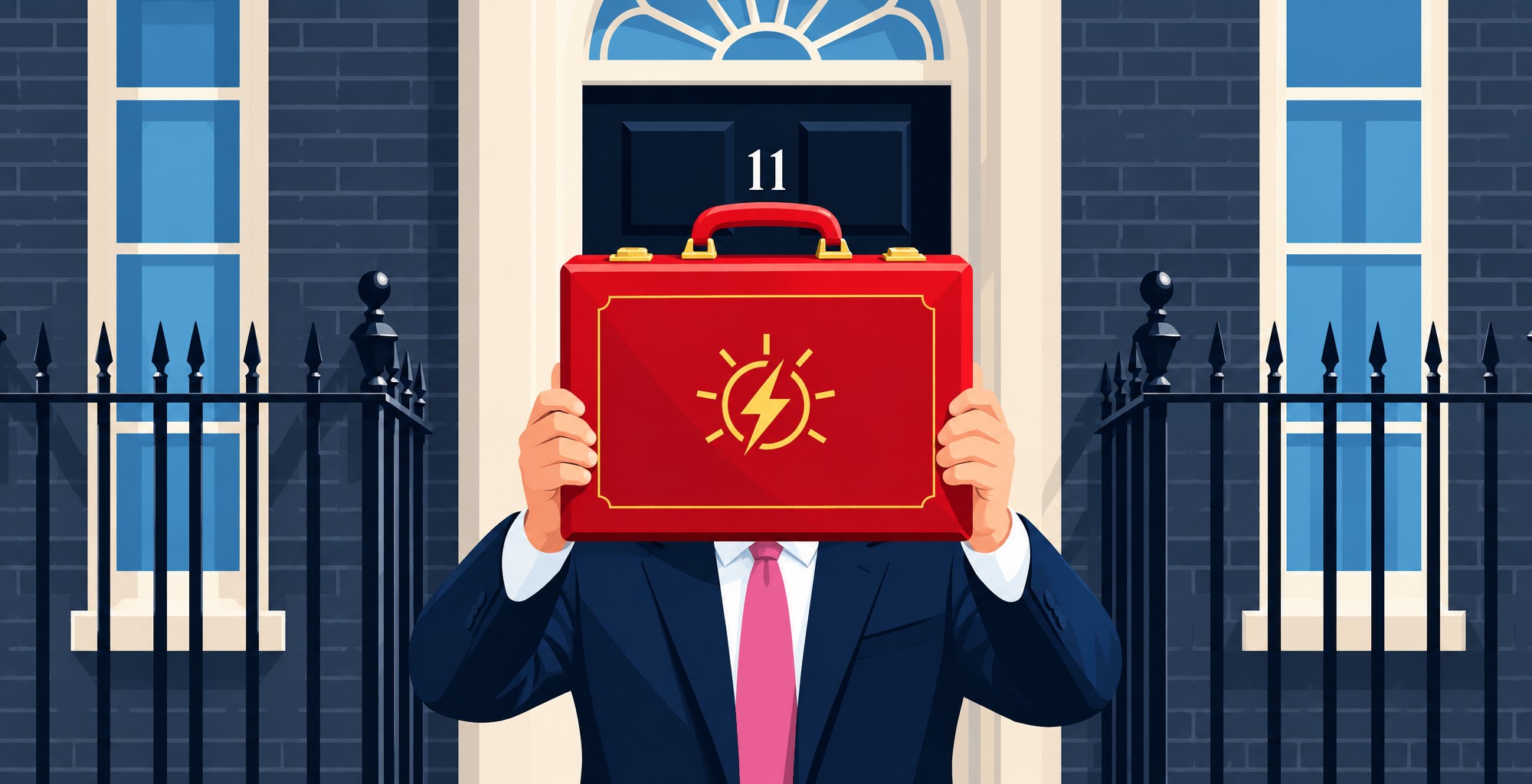
If I could slip five energy reforms into the Chancellor’s red box, these are the ones I’d choose. Together, they’d make clean electricity more attractive, protect people who need help and give innovative clean energy businesses a better chance to compete and scale.
More than 120 organisations, including Energy Systems Catapult, have urged the Chancellor to move policy levies from electricity bills into general taxation.
The coalition estimates that this could reduce business electricity costs by up to 20% and save households around £100 a year. That would help businesses compete, reduce operating costs and strengthen the case for switching from fossil fuels to electricity.
This month, the Energy Security and Net Zero Committee – whose inquiry into the cost of energy we gave evidence to, also called for remaining policy costs to be moved off electricity bills.
The government has already started moving in this direction, including shifting 75% of the domestic Renewables Obligation costs to the Exchequer and ending the Energy Company Obligation. The Budget should go further and move the remaining policy levies off electricity bills for good.
That doesn’t make the costs disappear. They still have to be paid for. Electricity bills are the wrong place to collect them when we’re asking households and businesses to electrify.
We put a carbon price on electricity generation, but not on the gas we burn to heat our homes. That imbalance works against electrification.
Our recent analysis recommends extending the UK Emissions Trading Scheme to gas heating. That would rebalance electricity and gas price signals over the long-term and give a stronger incentive to switch to cleaner alternatives.
Our earlier modelling shows it could cut emissions and raise money.
Those revenues could help pay for moving policy levies off electricity bills, whilst ensuring vulnerable households are protected.

The Prime Minister has also proposed removing gas standing charges. If costs are shifted onto unit rates, this could encourage lower gas consumption and help some households. But it could also weaken incentives to disconnect from gas altogether. Any reform needs to support the longer-term shift to clean heating.
Higher gas prices would hit some households particularly hard, especially those who can’t easily switch to cleaner heating. Ofgem has found that shifting the standing charge from gas would be broadly positive for low-income households though warned there are edge cases where the opposite is true. Low-income households with medical needs that force high energy use could be forced to disconnect devices to cut costs – such as the fridge needed to keep their insulin cool. Nesta predicts 14% of poorer households could be worse off if costs were moved to unit rates.
That makes better-targeted support essential to any reform of energy prices. We shouldn’t fix one distortion by creating hardship elsewhere.
Our Warm Home Prescription programme demonstrates what’s possible when support is tailored to people’s needs. Our latest evaluation found that 84% of participants could heat their homes to a healthy temperature after support, and 80% reported better physical and mental health. One in four used emergency GP and hospital services less.
That matters for the NHS too, which spends an estimated £900 million a year treating conditions caused by living in a cold or damp home.
The lesson is that targeted support can deliver more benefit than simply cutting everyone’s bill by the same amount. Using information including health data, we should target help at households that genuinely struggle to afford adequate warmth and design it around the outcomes we actually want. Keep people out of hospital and the potential savings are huge.
The UK is good at developing and demonstrating new energy technologies and services. We’re less good at helping successful homegrown innovations become mainstream businesses. Too often, companies prove that something works, only to find that regulation and market rules make it hard to sell commercially and scale.
Our work on secondary suppliers and regulatory diversity shows how regulation designed around traditional suppliers can create unnecessary barriers to innovative business models.
This matters for growth as well as for a cleaner, more resilient energy system. We need clearer routes from successful trials into the mainstream market, and regulations proportionate to risk, so new business models can compete and grow while consumers stay protected. Ofgem’s recent proposal to exempt smaller suppliers from the Universal Service Obligation – the duty to supply any household that asks – is a welcome step in this direction, but we need much more.
Innovation policy shouldn’t stop at proving that something works. It should help the best innovations reach the market and scale.
Reports that the government is considering cuts to the Boiler Upgrade Scheme are concerning. Cuts would undermine homegrown heat pump innovators, slow the transition to clean heating and weaken energy security. But protecting support for clean heat shouldn’t mean restricting it to heat pumps alone.
Instead, support should be diversified. Heat pumps will play a central role in decarbonising heating, but they’re not the only solution. Different homes and consumers have different needs, and policy should leave room for other options.
Heat batteries from innovators like tepeo are one example. The Catapult supported tepeo through our innovation programmes and, more recently, through trials looking at real-world performance and consumer experience.
Rather than picking winners, support should increasingly reward outcomes such as carbon savings and affordability. That would give consumers more choice, encourage competition and give emerging technologies a fairer chance to prove their value.
If I had to pick one place to start, it would be fixing the imbalance between electricity and gas prices. Moving policy costs off electricity while pricing carbon more consistently could lower costs for businesses and strengthen the economics of electrification – and, with targeted support for vulnerable consumers, protect households too.
But cheaper clean energy isn’t only a question of energy prices. We also need markets and regulation that let better technologies and business models compete, commercialise and scale.
None of these reforms are straightforward. Some involve hard choices about who pays, and none remove the need for public investment. But that’s the point of my fantasy Budget: instead of simply spending more on the energy transition, use the tax system, regulation and markets to make the money we’re already spending work harder.
Make clean energy cheaper. Protect those who need help. And make it easier for the best solutions to succeed. That’s the Budget I’d like to see.
Independent and technology-agnostic markets, policy and regulatory thought leadership tackling the hardest challenges on the way to clean energy innovation.
Find out moreFind out more about how Energy Systems Catapult can help you and your teams
Find out more about how Energy Systems Catapult can help you