Want to know more?
Find out more about how Energy Systems Catapult can help you and your teams
Get in touch
Want to know more?
Find out more about how Energy Systems Catapult can help you
It’s not often we get to quote the King in a blog – but his remark while introducing the government’s legislative agenda is worth repeating: “My ministers will also take forward recommendations of the Nuclear Regulatory Review and encourage a new era of British nuclear energy generation”.
The key question that follows is whether we will extract the full value from nuclear – unlocking not just its power, but the fertile ground it provides to nurture systemic change, grow innovation and scale high‑potential businesses?
For decades, nuclear power has been framed as ‘baseload electricity’ but our energy system is rapidly evolving. It’ll have much higher shares of wind and solar, electrified heat and transport, and a growing need to balance supply and demand through flexibility. In other words, how we use innovative generation and storage technologies to balance the grid by absorbing surplus energy and releasing it during peaks in demand.
Our latest Innovating to Net Zero work highlights this explicitly, identifying five distinct ‘peaks gaps’ that shape system design: Peak Power and Peak Energy (within-day balancing), Peak Daily and Peak Duration (multi-day balancing), and Peak Heat (balancing during bouts of extreme cold weather). These challenges bring huge opportunities for UK innovators to develop the flexibility solutions needed to smooth our peaks in power and heat demand – not only in our homes through consumer technologies and services, but at grid-scale too.
Nuclear plants could provide this flexibility not by ramping up electrical output but by switching what they produce – either electricity or hydrogen – while also supplying usable heat to large-scale heat networks and other heat demands.
In other words, using nuclear as a multi‑vector asset, not a single‑product generator, to bridge some peak gaps.
Treating nuclear as a flexible energy asset would open up new opportunities for innovators. Its abundant low-cost, high-grade heat can unlock energy- and cost-efficient innovations to develop and scale clean energy technologies like thermochemical electrolysers and direct air carbon capture and storage (DACCS). In turn, this creates the conditions for new markets, supporting everything from clean industrial processes to new hydrogen-derived fuels for greener shipping.
With that kind of resource base in place, nuclear provides flexibility and the foundation of an innovation ecosystem where businesses can co-locate, collaborate and grow.
It could look like this:
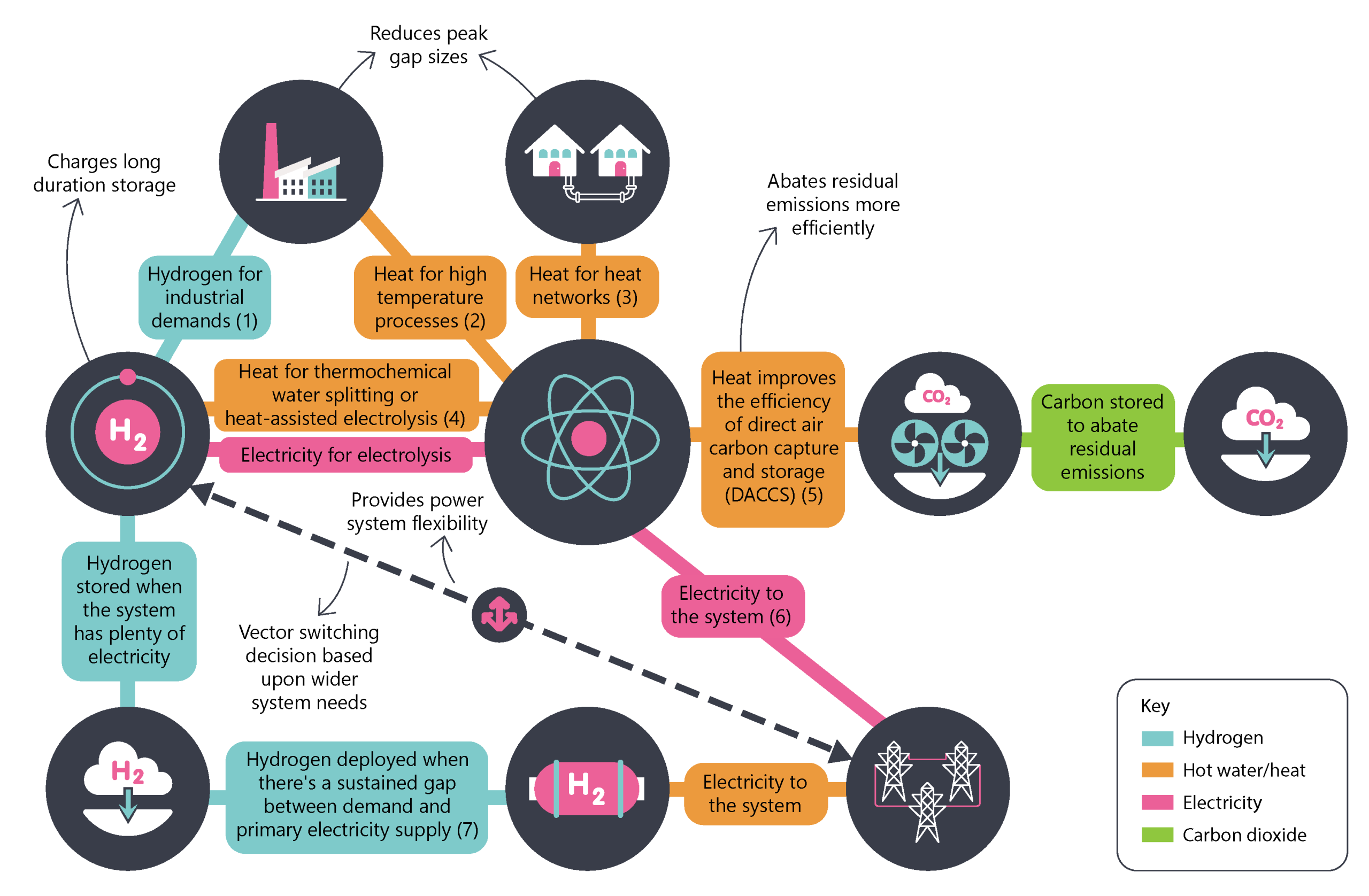
Nuclear power at the centre of a multi-vector energy system providing power, heat and hydrogen to interconnected sectors and innovators. (The numbers in brackets refer to relevant work we’ve delivered in these areas. The links to this work are available at the end of this blog).
This shift changes the conversation. It’s no longer about cost per kWh of electricity. It’s about the whole system value and why our whole system approach has consistently recognised the value of integrated nuclear power providing more than just electricity.
Let’s look at why that ‘multi‑vector’ framing matters – and why it changes how we evaluate nuclear.
Our Innovating to Net Zero research shows that higher renewable generation delivers the most cost‑effective energy system – but only if it’s matched by appropriate levels of flexibility.
The analysis suggests that a high‑renewables, high‑flexibility pathway can reduce overall system costs by around 1.5% (around £70 billion) by 2050, compared with a lower‑renewables pathway.
Similarly, our FlexMix project for Energy Systems Nexus found that very high levels of flexibility could reduce total system costs by £125 billion compared to an infrastructure-first approach.
This is not a story about finding one “silver bullet” for flexibility. Our Innovating to Net Zero findings emphasise that no single flexible technology is most cost‑effective across all peak gaps, and that the technologies best suited to within‑day balancing, the process of matching energy supply and demand in real-time or near real-time, differ from those needed for longer‑duration events.
Where does nuclear come in? It’s not a replacement for flexibility – but an asset that can reduce how much flexibility the system needs and provide additional flexibility through integration with other energy vectors.
Comparing nuclear solely as ‘electricity cost per kWh’ ignores two important realities:
This reframes nuclear as a candidate for multi‑vector infrastructure: generating electricity when the grid needs it, producing and storing hydrogen when electricity is abundant, supplying heat for networks and industrial uses.
Hydrogen produced by energy from nuclear plants will likely have a valuable role in future energy systems – providing fuel for shipping, aviation and power production – at times when the renewable supply isn’t high enough to meet demand. At that point in time, we need as much electricity production as possible.
The ‘flexible nuclear’ opportunity is to link these ideas:
The logic is straightforward: hydrogen production is dialled up to absorb surplus electricity and stored to provide energy security during longer periods of low renewables generation.
Meanwhile, utilisation of the nuclear plant stays consistently high – it’s the output energy vector that is changing.
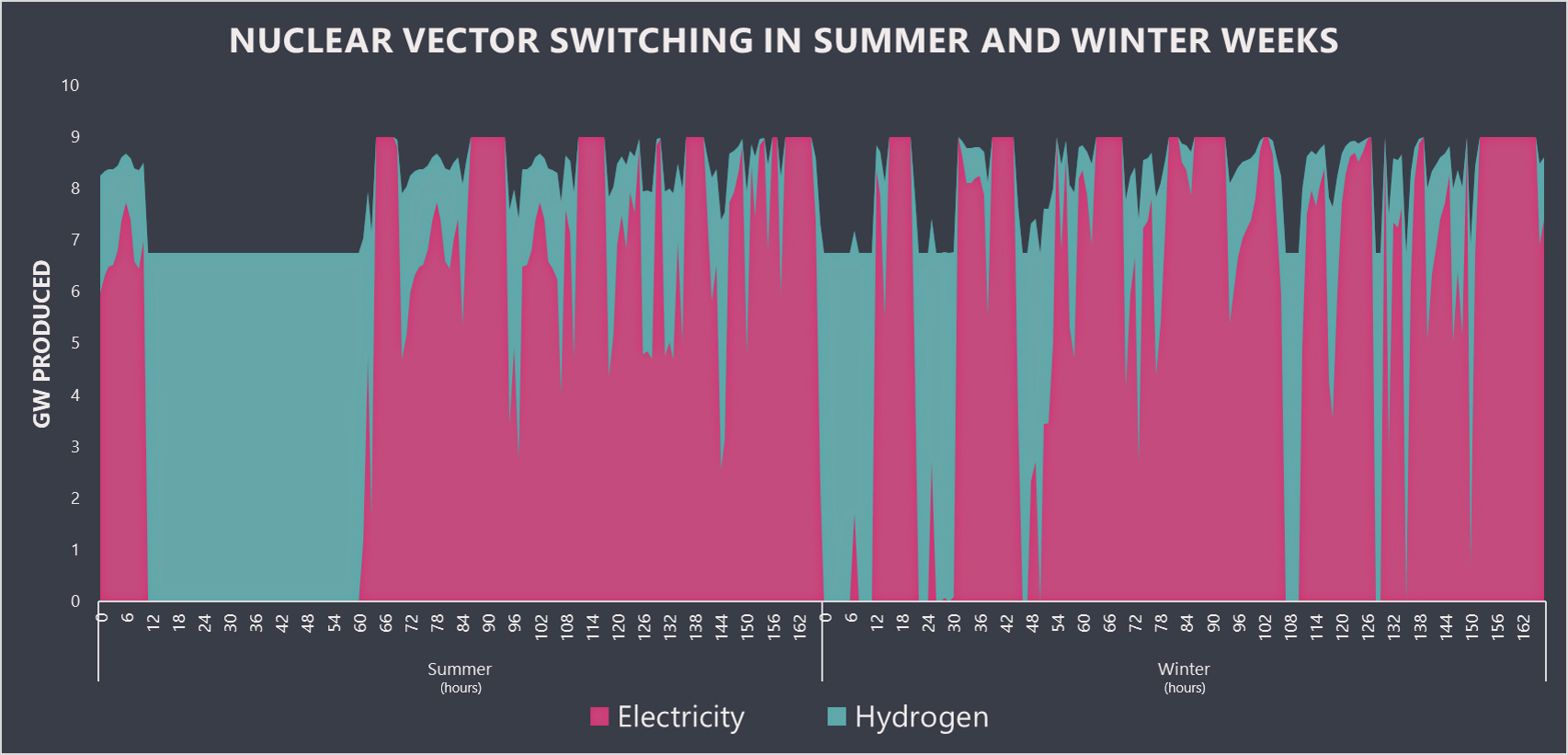
Taking some of the unpublished results from our Innovating to Net Zero research using our ESME Flex model, we can see that least cost systems use this ‘nuclear vector switching’.
The results below show this happening for hydrogen production and power generation in both summer and winter weeks:
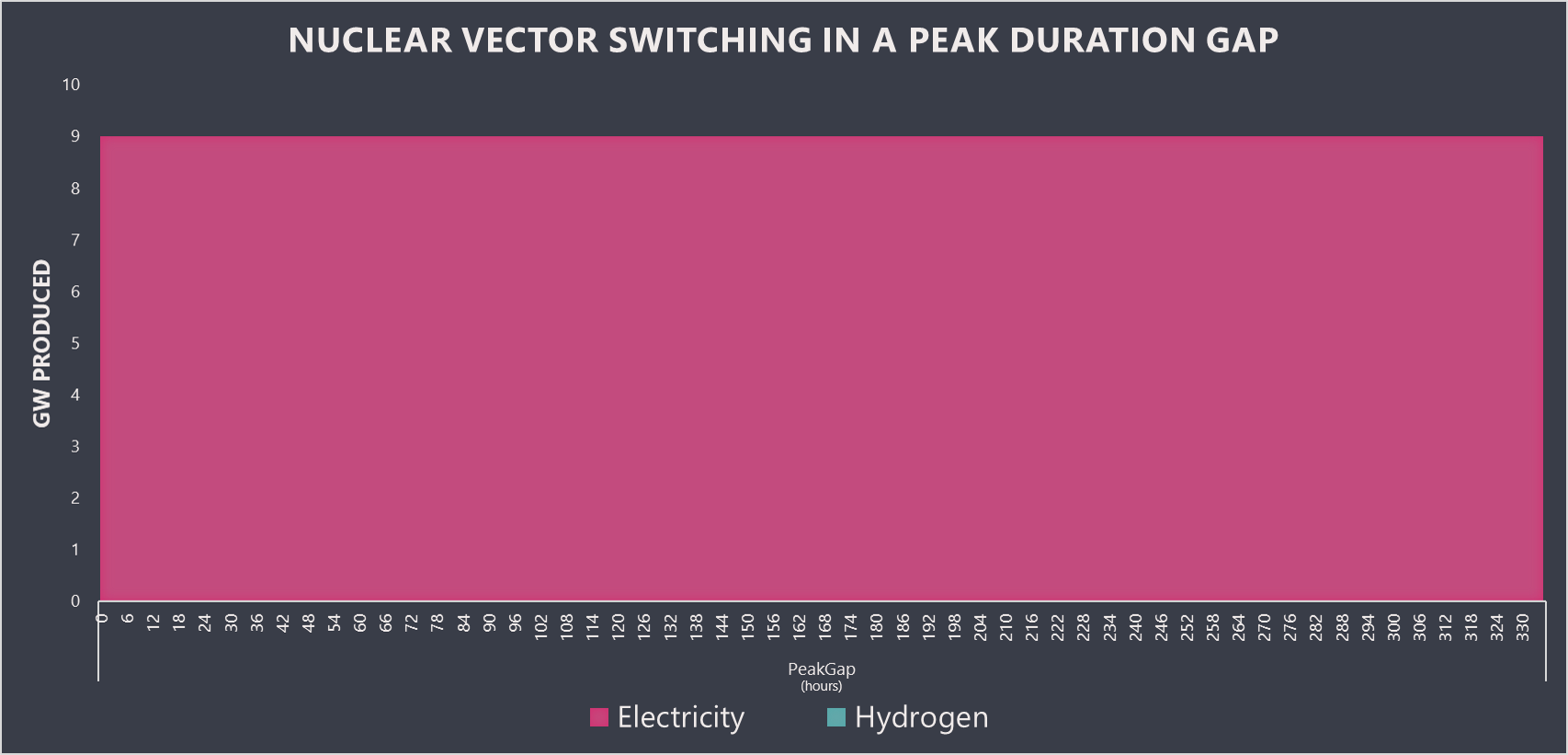
But then, when you need the electricity most during a Peak Duration Gap, nuclear operates in electricity-only mode for the entire time:
We know where all 24 GW of nuclear can be sited to support cogeneration for heat networks thanks to the Power Plant Siting Study published by the Energy Technologies Institute.
We have a heat network sector that is itching to build large heat network zones.
We have a government-backed hydrogen production business model and expect storage and hydrogen-to-power equivalents to follow shortly.
We have shown that nuclear provides fertile ground to scale efficient, complementary clean energy innovations.
And now we have the King introducing a new era of British nuclear generation.
Now we need to make nuclear a critical component of a multi-vector, energy-abundant, secure energy system.
Find out more about how Energy Systems Catapult can help you and your teams
Find out more about how Energy Systems Catapult can help you